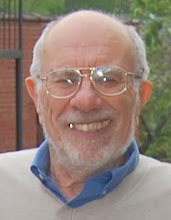
Tomorrow begins the new blog on Formal Methods in Political Philosophy. The link is at the end of this post. For some reason, I can no longer insert links. The URL of the new blog is http://robert-wolff.blogspot.com
Little by little, we explored other parts of Manhattan, even venturing as far south as Chinatown. One day, in an epic run, I hit every traffic light right from Canal to 115th and ran the entire island without stopping. My analyst lived only two blocks from the Madison Delicatessen, which had potato latkes to die for, so on occasion we would drive down for a meal. New York of course is the center of America's music world, but Cindy and I had very different tastes in music, so we rarely went to a concert.
Over time, we made connections outside of the Columbia community. One of the most rewarding for me was a friendship with Robert Heilbroner, best known for his incredibly successful book, The Worldly Philosophers. Bob was a genial, round-faced man whose face wore a perpetual smile. He was a democratic socialist and a deeply decent man who managed to combine a commitment to progressive values with a complete absence of ideological fervor. Bob was heir to the Weber and Heilbroner clothing fortune, and he and his wife lived in a fabulous Park Avenue apartment. Cindy and I were invited to a soirée one evening for perhaps thirty people. After a lovely buffet dinner, we were ushered into their large living room, where seats were set up for a concert. Bob had hired a professional concert pianist for the occasion, and we were treated to what can genuinely be called a chamber music concert. It was my one peek at the way the upper crust lived in New York. Barry Moore had given me a view of what might be called Edith Wharton money, old money. Bob was, so to speak, semi-new money, one generation old. I saw what really new money looked like through our rather odd friendship with George and Nedra Robinson. I had known George and Nedra at Harvard during my undergraduate days. George was now making big bucks on Wall Street, and the two of them had set themselves up in one of those vast pre-war Central Park West apartment buildings that John Lennon got shot in front of. Their living room was so huge that Nedra had been forced to furnish it with specially made couches and upholstered chairs that looked as though they had come out of a home on Brobdingnag. I never saw anyone actually sitting in them. George had lingering academic longings, which he indulged by taking up impecunious academics like me. Cindy and I saw Amadeus and Marat/Sade from orchestra seats as their guests.
But far and away the most interesting New York sub-culture of which I was given a glimpse was the Upper West Side intellectual New York Review crowd. Bob Heilbroner knew Bob Silvers, the editor of the New York Review. Silvers, in turn, knew the people who had organized a series of symposia called The Theater for Ideas, which met in a downtown loft used during the day as a dance studio. Attendance was by invitation only, and the guest list was an A-list of New York intellectuals. I was never a regular, but I did get invited to several of the symposia, most notably one devoted to "The Hidden Philosophy of Sigmund Freud." Sidney was actually on the panel, but for once he was eclipsed by others, including Bruno Bettelheim, the famous Chicago psychoanalyst, Holocaust survivor, and controversial therapist to autistic children. I was sitting in the front row, right in front of the stage. Next to me on the right was the composer William Schuman. Next to him was Sidney Hook. Behind me were Normal Mailer, Susan Sontag, and Sander Vanocer, among others. It was that kind of night.
Bettelheim gave a brilliant talk, one which I have referred to many times over the years in my own lectures on Freud. He said that Freud did not have a "hidden philosophy." Instead, Freud's life had been an endless "quest for the unconscious." The first person to pop up at question time was Hook, pugnacious and hostile as usual. "There is nothing new in what Freud did," Hook said. "Shakespeare could do that. Dostoyevsky could do that." And he sat down, satisfied that he had destroyed Bettelheim. "You are absolutely right," Bettelheim replied. "Shakespeare could do what Freud did. And Dostoyevsky could do what Freud did. But Freud taught us how to do it." Hook grumbled that Bettelheim hadn't responded to his point, but I thought it was the most brilliant rejoinder I had ever heard at a lecture. Then Norman Mailer got up, dressed in a tight-fitting vest and holding himself like a bantam weight boxer, and unloaded a fifteen minute diatribe against his current analyst, who was not in attendance. Things went downhill after that.
Cindy made fast work of her doctoral dissertation, and finished it that first year, but she missed Harvard's deadline for a June degree, and had to be content with receiving her degree the following January. Her dissertation director was the same Harry Levin who had misconstrued Bob Tracy's project. When Cindy had a complete draft, she sent it to Levin, and several weeks later took the train up to Boston to see him. I waited anxiously at Grand Central for her return, to hear how things had gone. Levin had laboriously changed most of her "which's" to "that's" and "that's" to "which's," but he had virtually no substantive criticisms at all, so Cindy sailed through. Meanwhile, she went looking for a job. Queens College offered her an Instructorship, since she did not yet have her degree, and she accepted. Starting in the Fall, we would both be teaching full time. Fortunately, I lived so close to my office that I never needed the car, so she could take it to drive out to Queens.
That first summer, I signed up once again to teach summer school. In those days, Columbia ran two five-days-a-week sessions each summer, and I taught two courses in each session. Cindy had grown rather depressed when she finished her dissertation, and I was very concerned about her. My first thought was to get her out of the city for at least a little while. My uncle Anoch and aunt Rosabelle had a summer home in Brewster, New York, about an hour's drive north of Manhattan which they offered to us for a couple of weeks, so we moved up there with our little cairn terrier, Fergus, and I commuted into the city to teach each day. My classes were scheduled so that I had several hours between the first and the second. I had not yet begun writing the essay I owed Art Danto by the end of the summer, the advance for which had long since been spent, so each day, I would walk over to our apartment, sit down at the old standard non-electric typewriter on which I had taken to doing my writing, and start banging away. The essay was supposed to deal with what was happening at the forefronts of the field, but I didn't actually know where the forefronts of the field were, and cared even less. Since I was pretty sure no one I knew would ever read what I was writing, I decided simply to write my own political philosophy. In several weeks, I had completed an essay of 80 pages or so, which I turned in to Arthur. Five years later, that essay saw the light of day as In Defense of Anarchism.
It seemed clear that Cindy needed psychiatric help as much as I did, so I asked Dr. Rodgers for a referral, and very quickly, it was decided that come September, Cindy would begin a full scale analysis. I was going to have to tap dance pretty fast to keep us from going deeply into debt.
When I accepted the Columbia job, I thought I would teach there until I retired. I had enough self-awareness to know that I had a tendency to shoot my mouth off, and I really did not want to make a bad impression, so I told Cindy that when I went to department meetings that first year, I was going to just sit and listen and get the lay of the land. There would be plenty of occasions later on for me to speak up. I imagine newly appointed Supreme Court Justices have a similar thought. When I went along to my first department meeting, I fully intended to be seen but not heard. As I walked into the seminar room where we met, Justus greeted me warmly. "Well, Bob, it is good to see you here," he said. "Since you are new, I imagine you won't want actually to take an active part in the deliberations for a while, but it is great that you are here to listen." Well, that settled it. I didn't shut up until I left in1971.
Right away, the department was faced with the necessity of making some decision about the future of the junior members. There were three of them: Arthur Collins, Martin Golding, and David Sidorsky. I had not yet gotten to know them very well, of course, but the other senior members of the department had arrived individually or collectively at pretty clear opinions about each of them. Everyone agreed that Collins was the most promising philosopher of the three. Since Arthur was really an able man, Ernest Nagel felt himself free to judge him by the highest possible standards, and what Ernest thought would greatly influence many other votes. Ernest decided that Arthur did not quite come up to snuff for a tenured professorship at a great Ivy League university. That killed Arthur's chances, and the next year he managed to get a job at City College. Martin Golding's field was the philosophy of law, which was one of Ernest's minor sub-specialties. We all waited to hear what Ernest had to say, but was not willing actually to offer an opinion. It seemed to us pretty clear that if Ernest didn't think Arthur made the grade, then he wouldn't think that Martin did either, but Ernest was mum. So it was decided to send Martin's work out to three or four of the most eminent philosophers of law in the English speaking world. Well, you know what happened. Those distinguished gentlemen assumed that we had already decided to promote Martin and were simply going through the motions, so they wrote back puffs, and we were stuck. There was no way we could vote no if all the biggies in the field said he walked on water. Martin got tenure.
That left David. Now, about David there was complete agreement. He was a disaster. The question was not even close. Nobody in the entire department thought David deserved tenure, but David was a nice Jewish boy [well, at least he was Jewish], and there was very serious doubt that he could get another job if we dumped him. The more senior members were actually prepared to keep him around forever simply because they couldn't bring themselves to vote him out. Sidney, Arthur, Jim, and I had lunch, and we agreed that David had to go. There were four of us, and the four no's rule was still in effect. We agreed that we would all vote no when the secret ballots were handed around, and Sidorsky would be history. At the next meeting, we took a vote. When Justus counted the votes, there were three no's and one abstain. Arthur and Jim and I looked at each other and all shook our heads. We had stuck by our agreement. Then we looked at Sidney. He shrugged, with a sweet sad look on his face. That was forty-five years ago. The last I looked, Sidorsky was still a senior professor in the Columbia Philosophy Department.
The year after I joined the department, we faced a full-scale crisis. The Rockefeller Institute, a premier biological research institute founded by John D. in 1901 and situated the east side at York and 63rd, decided to become a University. The first thing it needed, of course, was a Philosophy Department. They didn't have any students or a campus to speak of, but they figured a Philosophy Department would show that they were serious. So they set out to buy themselves one. They called Ernest and offered him a professorship. Now, the year before,
Columbia had created the exalted rank of University Professor, appointing the great physicist Isidor I. Rabi as the first holder of that title. The next year, the great art historian Meyer Schapiro was also elevated to University Professor. [The story is that Schapiro got a really fat offer from Harvard and went to see the Provost, Jacques Barzun, about it. Schapiro had been one of the first Jews to get tenure at Columbia, a fact Barzun was not above playing on. When Schapiro told Barzun the terms of the offer, Barzun said, "Oh, Meyer, I am ashamed of you. How can you think about money? You are a member of the Columbia family." Barzun bought Schapiro off with a University Professorship, and Schapiro went away embarrassed.]
Ernest was a good friend of both Rabi and Schapiro, and he dearly yearned for the status that attached to the sciences. So he went to Barzun and said he wanted a University Professorship like Izzie and Meyer. Barzun said no. Why did Barzun say no? I have always thought it was because he just wasn't willing to populate the ranks of the University Professors with Jews, but I am sure that is a blood libel, so forget it. Anyway, Ernest left in a huff for the East Side.
The department was thunderstruck. Ernest had been at Columbia forever. Ernest was the Columbia Philosophy Department. What were we going to do? Obviously, the only solution was to recruit the biggest name we could find to take Nagel's place, and hope that the department was not summarily downgraded in everyone's private rankings. [What follows repeats and expands on a story I told at the very beginning of this extended Memoir. I apologize to my most faithful readers.] We met to discuss possibilities, and very quickly it became clear that Justus was not on board. Each time a name was mentioned -- Quine, Goodman, Chisholm, Sellars -- Justus objected that he was not good enough for us. After a while, I grew just a trifle exasperated. "Justus," I said, "is there anyone in American philosophy whom you would like to see us hire?" Justus thought about that seriously for a moment, and said, "No." "Okay," I said, "Is there anyone in the world you would like us to hire? Never mind whether he can speak English." "No," said Justus. Beside myself, I came back, "Never mind alive! What about Descartes?" "Too diminished a conception of experience." "Kant?" "Not adequately clear on the nature of being." "Is there anyone in the entire history of philosophy who would be good enough to join us?" Justus gave that some serious thought. Finally, he allowed, "Aristotle, and Whitehead."
But Justus was a good soldier, and if the department voted to make an offer, he was prepared as Chair to represent our collective will. We tried Quine. No soap. Chisholm, Also no. Goodman. No hope there. At one point we tried Kripke, who was then still a very young man. Justus made the call, but as it happened, it was the Sabbath, and Saul refused to come to the phone. Along about then, I began to feel real sympathy for Justus. This being before the big upheaval, there was no question of the graduate students playing any role in the proceedings, but of course they caught wind that something was up, and they came to Jim Walsh, demanding to know why we weren't hiring someone to replace Nagel. Jim called a formal meeting of the graduate students kin the seminar room, and they all crowded in. "All right," Jim said, "we are going to play a game. You tell me whom you would like us to hire, and I will tell you what he said when we called him." The students looked a bit puzzled, but they gave it a go. Every time they came up with a name, Jim would simply repeat what that potential candidate had responded. We had tried them all.
The Rockefeller was in the process of hiring themselves a pretty classy bunch of philosophers. Over the next decade, they rounded up Donald Davidson, Saul Kripke, Harry Frankfort, Margaret Wilson, and many others. But the experience of actually being at the Rockefeller was rather soul-numbing. Scientists work in groups in labs, so there is always some socializing and that goes on. But when Nagel showed up, they gave him an office, measured him for a desk, and said, "All right. Welcome. Now think." It drove Ernest nuts. After only one year, he came crawling back, asking to be rehired at Columbia. And now, Columbia made him a University Professor!
Showing posts sorted by relevance for query ernest nagel. Sort by date Show all posts
Showing posts sorted by relevance for query ernest nagel. Sort by date Show all posts
Tuesday, May 4, 2010


Wednesday, March 7, 2012
ENOUGH IS ENOUGH
I have been a political junkie all my life. My earliest political memory is the day FDR died [I was eleven]. At fourteen, I went to a Henry Wallace rally at Yankee Stadium [but it rained, and I ended up watching a no-hitter at the Polo Grounds -- you can look it up in my Autobiography.] What really brought home to me my political addiction was an evening I spent in 1966 in a Cotswald cottage outside London. A brief explanation is called for.
Ernest Gellner was a very well known and widely read Czech-English philosopher, sociologist, and anthropologist who made a big name for himself in 1958 with the publication of his first book, Words and Things, an excoriating attack on the so-called Ordinary Language Philosophy that was then all the rage in England, and was leaking over into the United States. Shortly after the book came out, Gellner spent some time in Cambridge, MA [and, if memory serves me, went out briefly with my big sister, Barbara, who was then taking a doctorate in Biochemistry at Harvard.] I got to know him, and we became friends. For years, we corresponded and on rare occasions saw one another.
In 1964, when I went to Columbia University, one of my new colleagues was Charles Frankel, a student of Ernest Nagel who did social and political philosophy [tragically, some years later, Frankel and his wife were killed in their home in Westchester during a robbery.] Charlie was pretty far along in organizing an international conference for the Social Science Research Council, to be held at a posh villa in Italy, when he was tapped by LBJ to be Assistant Secretary of State for Cultural and Educational Affairs. He asked me to take over the last few organizational chores for the conference, which I did. On my way home from the conference, I passed through London and took the opportunity to visit Gellner and his wife and family in their Cottswald cottage. The date was March 31, 1966, which just happened to be election day in England, so after dinner was over and the children were put to bed, Ernest, his wife, and I sat down in the little living room and watched the results on an old black-and-white television set. I had not the foggiest idea who any of the candidates was, and aside from a general preference for Labour, no clue what the election was about. And yet I watched mesmerized as the results came in and were put up on chalk boards by the commentators. It crossed my mind, as I sat there, that I must really be a hopeless political junkie if I could be fascinated by election results in a contest I knew nothing about.
All of which brings me to last night, which was Super Tuesday in the Republican Presidential Primary race. I have been following every up and down of this seemingly endless process with the obsessive attention appropriate to a political junkie. I watched in horror as Bachmann rose and fell, as Trump wafted into the stratosphere like a child's balloon slipped from its fingers and then popped, as Perry self-destructed, as Cain had his moment in the sun, as Gingrich did his best to steal Christmas. Good grief, I even read the man's doctoral dissertation. How much deeper in the weeds can one go?
But as the weeks have turned into months, and a year and more has gone by, I feel like a little boy who has finally been taken by his parents to a Ringling Bros. Barnum and Bailey circus, only to discover that it is clowns all the way down -- no trapeze artists, no lion tamers, no jugglers, not even a pretty lady equestrian, just one clown after another with a silly grin painted onto his face hitting his fellow clowns with a slapstick and staggering around the center ring in oversized shoes. I never thought I would hear myself saying this, but at long last, I just don't care. Last night, I watched Rachel Maddow and John Heilmann and Michael Steele and Chris Matthews vamping for hours until the first results dribbled in, and as the numbers started appearing on the screen, I gave it up and went to sleep.
Oh, I will watch the conventions -- both of them -- and I will settle in for election night with a pizza and a bottle of good red wine. But for the moment, I have had about as much of Romney and Santorum and Gingrich and Paul as I can stomach. Will someone please pile them back into the tiny car they tumbled out of and drive them off stage?
Thursday, April 29, 2010
MEMOIR VOLUME TWO CHAPTER THREE FIRST INSTALLMENT
Chapter Three Columbia University in the City of New York
Columbia gave us one of its rent controlled apartments, and we moved in when we got back from Europe. Five rooms, kitchen and bath for $108.50 a month, although after we had them install a new fridge, they upped that to $111.50. Even in 1964, that was a fabulous bargain. The apartment was a slum, but I was about to go into full-scale analysis, which would cost a sizable portion of my annual salary, so I grabbed it. [I only realized the apartment was a slum some years later, when I was idly watching a public television special about efforts to renovate a block in Harlem. The did a before-and-after sequence on an apartment being upgraded, and during the before segment, as the camera panned around the ratty looking apartment, I suddenly had an epiphany. "My God," I thought, "that looks just like our apartment. We live in a slum!]
There are striking similarities between the physical locations of the University of Chicago and Columbia, but also major differences. Like Chicago, Columbia is situated cheek-by-jowl with a large Black community -- the most famous Black community in America. Like Chicago, Columbia bought up real estate and managed it in an attempt to preserve a White enclave. But whereas Chicago is insular, inward-looking, isolated from downtown, Columbia bleeds into Manhattan so that it is sometimes difficult to feel where the university stops and the rest of the city begins. Not for nothing does Columbia call itself "Columbia University in the City of New York."
The bulk of the university consisted then of a rectangle oriented north-south, with Broadway on its west flank, Amsterdam Avenue to its east, 114th street to the south and 120th street to the north. The cross streets from 115th to 119th were blocked off, creating something of a campus, although it did not feel like either Harvard Yard or the Quadrangle. The heart of the university was a large grassy open area crisscrossed by walks, with the administration building, Low Library, at the north end and the real library, Butler, at the south. If you have seen Ghostbusters or the Barbra Streisand Jeff Bridges movie The Mirror Has Two Faces or countless other films, you have seen that space. It is one of the most recognizable places in Manhattan.
Columbia sits on the upper west side of Manhattan, in a community called Morningside Heights [think Annie Hall]. If you stand on either Broadway or Amsterdam and look south, you see a long straight avenue going downhill for quite a stretch. Columbia is perched almost on the highest part of the Heights. Our apartment was half a block from the university: 415 W. 115th st., apt. 51. That portion of 115th street is a single block between Amsterdam and Morningside Drive, so I was not even two blocks from my office in Philosophy Hall. Morningside Drive runs along the western edge of Morningside Park, a vertiginously steep bit of land that falls away from Morningside Heights to Harlem below. It quite effectively divides the university from the Black community. Little did I know, when I moved into our new home, what an important role that park would play in the most dramatic events of my Columbia stay.
My first priority was to get to know the group of department members who would, I confidently expected, be my colleagues for the rest of my life. Since the Academy, whatever its politics, is a deeply conservative institution, propriety dictates that I begin with the most senior of my new colleagues. When I arrived in 1964 as a bright-eyed, bushy-tailed young Associate Professor, there were four grand old men in the Department who collectively embodied the ethos of the Columbia that had once been. Pride of place must be given to John Herman Randall Jr., who was sixty-five. [As I write these memoirs, I am back in that time, seeing things in my mind as I experienced them. Randall and the others will always be, to me, ancient relics, distinguished, hoary, survivors of a bygone age. The fact that I am now eleven years older than Randall was then makes no impression on my memories whatsoever.]
Randall had made his name, at the age of twenty-seven, with the publication of The Making of the Modern Mind, and had an enormous, and deserved, reputation in the Columbia community. He had been one of the architects of the famous Contemporary Civilization course required of all undergraduates, Columbia's answer to the Hutchins revolution and a forerunner of General Education at Harvard. Randall's principal focus was on the Greeks, so we did not really have much in common philosophically, but he and his wife, Mercedes, very graciously invited Cindy and me to dinner shortly after we arrived, as a welcome to the department. The Randalls lived in a big pre-war apartment on Claremont, a little street squeezed between Broadway and Riverside Drive that was home to some of Columbia's most sought after rentals. When we walked into the book-lined living room, the first thing I saw on the shelves was the complete multi-volume edition of the works of Immanuel Kant. The Prussian Academy edition is the holy grail for Kant scholars, and by the time I came along, a set was fabulously expensive. I thought, "This is what academic life is supposed to be!"
During dinner, Jack and Mercedes regaled us with stories of Columbia in the old days. Mercedes explained that when you were an Assistant Professor, you had a maid who came in before breakfast and left after washing up the dinner dishes. Once you got tenure, however, you hired a full-time servant who lived in a little room behind the kitchen that had its own bathroom. She cooked, cleaned, and baby-sat, and each summer, when you went to Europe, she came along to look after the children and handle the trunks. For a brief moment, I had a glimpse of an era that would not, I was sure, come again.
Two other senior professors, Horace Friess and James Gutman, were less academically distinguished than Randall, but both had played important roles in the Ethical Culture Society, a progressive, secular spinoff of Reformed Judaism founded by Felix Adler in the 1870's. The Society, readers of the earlier portions of this memoir will recall, had been responsible for the creation of the Child Study Association, where my mother worked until her first heart attack in 1950. It was through Child Study that my parents found Shaker Village Work Camp for me, as well as Dr. Bertram Schaffner, my first psychiatrist [Memoirs, Volume One, Chapter One -- see Blog post, June 28, 2009]. Algernon Black of the Ethical Culture Society was also the founder of the Encampment for Citizenship, where my sister danced with Marshall Cohen. In coming to Columbia, I was entering a world that was complicatedly intertwined with my family.
The fourth grand old man was Ernest Nagel, a distinguished philosopher of science and the teacher or mentor of several of the younger men in the department. Nagel was really more like my adoptive uncle than a colleague. He was just nineteen days older than my father, and the two of them had known each other as undergraduates at City College, along with my uncle Bob, then a professor of Astronomy and Physics at CCNY, and Sidney Hook. I still have an old photograph of my father, my uncle, Nagel, and my grandmother gathered around a little telescope in the Catskills, where my grandmother took the children every summer.
Only slightly younger than Randall and the others was the great humanist scholar Paul Oskar Kristeller. I had encountered Paul's work on The Renaissance while preparing myself to teach Soc Sci 5 at Harvard, and, as with Alan Gewirth at Chicago, I was tremendously impressed that I was going to be able to call myself his colleague. Paul had been educated in Germany, and was then forced first to flee Germany and then Italy because of the rise of fascism, a fact that played a large role in his reaction to the events of '68.
Tuesday, May 18, 2010
MEMOIR VOLUME TWO CHAPTER FOUR SECOND INSTALLMENT
I confess that I found the behavior of my new colleagues rather puzzling. These people apparently thought of themselves as analytic philosophers. Well and good. Before I turned eighteen, I had studied with Willard van Orman Quine, Nelson Goodman, and Hao Wang. I knew more logic than they did, and in my own work, I used mathematics a good deal more sophisticated than anything they knew or ever used. What on earth were they so uptight about? It took me a very long time to develop some sense of who they thought they were and what they thought they were doing. The short of it seems to have been this: Having taken over what they thought of as a somnolent department, they were intent on turning it into a world-class outpost of whatever it was that Roderick Chisholm did at Brown. John, Ann, Leonard, Bob, and I were so much dead wood, in their view, taking up places that could be better filled with real philosophers.
Something else was going on that I had never encountered before, although I understand that it is rather common in Philosophy departments around the country. These men had formed themselves into a clique, around which they gathered a favored group of the students in the graduate program. Once Fred Feldman got his hands on the administrative position of Graduate Program Director -- usually a chore shoved on some poor unsuspecting junior member of the a department -- he used that position to advance an agenda. The favored in-group of students were given such Teaching Assistantships as the department had available. Feldman counseled students against taking my courses or those of the other outsiders. He formed dissertation committees so that we would be excluded from them, especially if the committees were for the in-group of students. There was a good deal of snide, smarmy, snickering smirking about the our unphilosophical work.
At one point, I served on a committee with Gettier and Robison whose task it was to divide up the available merit money for raises. [Because this was a State university, this task was handed to the department, rather than being reserved for the Dean]. Leonard Ehrlich had just published a book on Jaspers, so I proposed that he receive a merit raise. Neither Robison nor Gettier had ever published a book, of course, but that did not stop Robison from rejecting the proposal, saying that it would have been better if Leonard had not published the book.
I found this behavior appalling, mystifying, and simply infra dignitatem. In every one of the departments of which I had previously been a member, there were of course some professors whom the students thought of as the stars and others who were regarded as of lesser distinction or even intelligence. Everyone at Harvard knew that Quine was just plain smarter than Donald Williams or John Wild [or anyone else, for that matter], but every member of the department was treated with courtesy and accorded at least pro forma respect. At Chicago, we youngsters had waged a battle against the oppressive reputation of Richard McKeon, to be sure. Still, no one was kept off dissertation committees. At Columbia, as well, those of us gathered around Ernest Nagel thought of ourselves as the new wave, but we had great respect for Justus Buchler, for Jack Randall, for Jimmy Gutmann, and the rest of the old timers. It would never have occurred to any of us at those places to say, or even think, that what they did was "not philosophy." I am afraid I reveal my elitist upbringing when I say that I thought of my colleagues as just never having learned how a gentleman or gentle lady behaves in the Academy.
As the years went by, Bob and I grew more frustrated with the party-line, lockstep behavior of the members of the majority. When we attended a department meeting to discuss a candidate for the department or a proposed change in the rules of the graduate program, there would be a lively discussion that gave every appearance of being a genuine exchange of views, but the votes were always the same. After a while, Bob took to playing a little game. At the beginning of each discussion, he would quite visibly lay a folded piece of paper on the desk. After the vote was taken, he would unfold the paper. There on it would be written the vote count. He was never wrong.
Oh, there were moments when it appeared that one or another of the boys was going to side with us on some issue, large or small. The Olympia Snowe of the department was Gareth Matthews. He sighed, he meditated, he hesitated, he weighed the pros and cons, he acknowledged the merits of our side of the debate, he confessed that he was seriously tempted to endorse our view. But always, in the end, our arguments were just not quite strong enough to win him over. In the twenty-one years that I sat in those meetings, not once did Matthews ever break from the party line. Mitch McConnell would have been impressed.
At one point, after years of frustration, Bob, Ann, John, Leonard, and I went to the then chair, Mike Jubien, to propose that we be permitted to design a Master's Program in Political Philosophy and Continental Philosophy, in order to give us some role, however secondary, in the graduate program. Mike's response was to suggest that it might be better if we left the department.
All of this gets me way ahead of my story, for at the end of that very first year on Barrett Place, something happened that had a far greater impact on my life, and the life of our family, than the small mindedness of my colleagues in philosophy. On July 11, 1972, the American chess prodigy Bobby Fischer squared off against the world chess champion Boris Spassky in Reykjavik, Iceland for the championship of the chess world. There were no live television feeds in those days, but public television committed itself to a series of programs in real time reporting on the match. PBS recruited Shelby Lyman to host a program in which, as each game was played, he would receive telephoned reports of the moves and put them on a chess board hanging on a wall with slots for the pieces. Lyman himself was not a very strong chess player, although he had done yeoman work for the United States Chess Federation [USCF] in promoting the game. With him in the studio, however, were some of the strongest players in America, and as each move was announced, they would analyze it, try to divine the strategy behind it, look for traps and loopholes, all the while pretty much rooting for Fischer.
I had learned chess from my father, and though it was not my favorite game -- I preferred the game of Go -- I took out my lovely wooden chess set, set up the pieces on a board in the family room, and followed along as Lyman announced the moves and the experts analyzed them. Little Patrick was four and a half then, still improving his talking [he was a late talker], but he watched me as I stared at the television set. Something clicked inside him. The next year, when he was attending the Smith College Campus School, he asked me to come to an Open House of the school, which was just down the hill from our house. I went along and followed him as he showed me his school. In one room, the teachers had set up a variety of board games on the floor -- Monopoly, checkers, Chinese checkers, and chess, among others. Patrick pulled me to the chess board and said, "Teach me that." "Well," I said, "that is a rather complicated game. How about this one?," pointing to checkers.
Patrick was adamant, so when we got home, I took out the chess board and taught him the moves. Immediately, he wanted to play a game against me. I took him through a game, which in the end I won. Patrick was very upset by that, and wanted to play again. Pretty soon, we were playing every day. At first I won all the games. Then I let him win some. Then he won some on his own, and it became a genuine contest. Several years later, I bought Patrick a copy of Bobby Fischer's book, My Sixty Favorite Games. He taught himself to read chess notation more or less at the same time that he learned to read words. In the morning, when I woke up, I would hear him in his room, playing chess, the pieces clicking as he put them down on the board.
So began a long, complex journey that ended, many years later, with Patrick becoming one of the strongest chess players in America, an International Grandmaster known throughout the entire chess world, twice the United States Champion, a second to Anand in his world championship match against Kasparov, a widely read chess journalist, and for some years in his twenties, a chess professional who supported himself over the board. That is a very long story, to which I shall return many times. One of the most fascinating and challenging conundrums I faced as a father was how to raise Patrick as a healthy, happy, normal boy, while at the same time acknowledging, supporting, and endorsing his emergence as a force in the world of international adult chess.
I have spoken about the inwardness of Patrick's nervous system as a baby. That quality manifested itself in many ways as he grew older. While still a little boy, he exhibited extraordinary powers of concentration. As a three year old, he loved those wooden PlaySkool puzzles consisting of six or eight big pieces that fit into a wooden frame to make an elephant or a flower or a dog. He would sit on the floor fitting the pieces into the frame, so absorbed that if his back was turned when I walked into the room, he would not hear me say, "Hello, Peege." [Peege was my nickname for him, derived from his initials, P. G.] Alarmed, we had his hearing tested at the world-famous Clarke School for the Deaf, which was several blocks from Barrett Place, but there was nothing wrong with his hearing. He was just concentrating.
I thought of that some years later when I took Patrick, now a boy of twelve or thirteen, to a big deal tournament in New York City featuring some of the strongest players in America. Patrick sat down to play his first game, which like all serious chess games was played under time constraints. Each player in the tournament had two hours to make the first forty moves [a time control known in the chess world as "forty and two."] Patrick had the black pieces, so his opponent made the first move and pressed the plunger, starting Patrick's clock. It was an opening move that Patrick had not seen before. He stared at the board, put his chin on his hands, and thought. And thought. And thought. An hour and a half went by, while Patrick did not move a muscle, his two hours ticking away. Finally, Patrick lifted his hand, made his first move, and went on to win the game.
What did chess mean to Patrick, to absorb so completely his attention and youthful energies? I got a clue several years later. I had taken Patrick to school with me, "to see where Daddy works," and on the way home I took the back way on Rocky Hill Road to avoid the traffic on Route 9. When we drove past the cemetery, Patrick pointed to a small mausoleum and asked what it was. "That is a place where someone is buried," I said, "and his family have put up that structure to remember him by. It is called a mausoleum. Sometimes people put statues on top of them." Patrick thought about that for several miles, and then said, in a quiet voice, "I know what would be a good mausoleum for you, Daddy." "Oh yes," I said in the calmest voice I could muster, clutching the steering wheel firmly with both hands, "and what would that be?" "Well," he said, getting rather excited, "it would be laid out like a chess board, and the white king would be turned over on its side, showing that it had been mated." After that, I ceased wondering why Patrick was playing chess.
Since I will be returning to Patrick's chess career a number of times in these memoirs, perhaps this is as good a time as any to explain a little inside baseball to those readers who are not familiar with the world of competitive chess. Chess in the United States is overseen by the U. S. Chess Federation, or USCF. The USCF organizes and authorizes tournaments and keeps careful records of how everyone does in them so that it can apply its complicated formula to the results and calculate everyone's USCF chess rating. The ratings run from a low of about 200 for absolute novices just learning the game, to as high as 2700 or even higher, for world famous players. A rating of 2000 earns you the title of "expert." [Below that, you are an A, B, C, D, etc player]. At 2200, you are awarded the title of Master, and at 2400 the title of Senior Master. Whenever two players play a game, the USCF uses a formula to calculate the probability that the winner will beat the loser, based on their ratings before the game. The bigger the gap between the two players, the more rating points the weaker player gets if he wins, but the fewer points the stronger player gets if she wins [the theory is that the stronger player figured to win anyway.] After each tournament, each player's rating is updated to reflect his or her record against the players he or she beat or lost to in the tournament. Over time and many games, a player's rating comes to reflect pretty accurately his or her strength over the board.
This is all just in America. In the world at large, chess is overseen by the Féderation Internationale des Eschecs, or FIDE. The same formula is used for calculating FIDE ratings, but in general your FIDE rating is somewhat lower than your USCF rating. You can only earn FIDE rating points by playing in FIDE sponsored tournaments against other players with FIDE ratings. The really strong players are the ones who have earned the title of International Master or International Grandmaster, this latter being the highest title one can earn. You cannot become either an IM or GM simply by accumulating points. You must play in a very strong tournament entered by a number of players already holding those titles, and your performance must be at a level judged [by a formula] to be of IM or GM quality. Each time you do that you "earn a norm," and after earning three IM norms or GM norms you become an IM or a GM. Once awarded by FIDE, that title is yours for life.
All of this lay far ahead of Patrick when we played our little games, and neither of us at that point knew anything about the USCF, FIDE, ratings, norms, or the rest of the arcana of the chess world.
What of little Toby, Patrick's brother? I must now confront a problem that bedevils all memoirists. In my mind, I am back in the early 1970's, when both Patrick and Toby were little boys. But I am writing these words in 2010, when I know, of course, what both of them have become. That darling tow-headed little one and a half year old boy is now forty years old. He is a brilliant law professor, the leading young civil proceduralist in the American legal profession. He is also a handsome, proud gay man who served as the Co-Chair of the Advisory Committee on LGBT issues to the Obama campaign, and is the leading voice in the country on LGBT legal issues. He has long ceased -- and here I write with just a tinge of parental regret -- to be "Toby" either to the world or to his family. He is now "Tobias," Professor Tobias Barrington Wolff of the University of Pennsylvania Law Faculty.
There is an old story about Mrs. Shapiro, who takes her two little baby boys out in the stroller for a walk. On the street in front of her apartment she runs into Mrs. Finkelstein, who coos and says, "Who have we here?" Mrs. Shapiro replies, "The one on the left is the doctor. The one on the right is the professor." I hope I am not simply channeling my inner Mrs. Shapiro when I say that I have two trophy sons.
It was not difficult to see, very early on, that Patrick was headed for distinction, but what of little Toby? He was not a precocious child, in the way that Patrick was. To be sure, since Toby learned to talk early and Patrick learned to talk late, it seemed as though they began to speak at roughly the same time. And the difference I perceived in their nervous systems in those very first weeks continued to unfold. Toby was as outgoing as Patrick was inward-looking. This was difficult for Toby, who wanted to play with his big brother but was repeatedly rebuffed. "It's not fair," Toby would protest. "Patrick won't play with me." "Sure it is, Toby," Patrick would respond. "I don't want to play with you either." [There was just a hint of Sidney Morgenbesser in Patrick, I am afraid.] Patrick could spend an entire semester in school without really getting to know the children in is class. Toby would come home the first day knowing not only the names of his classmates but the names of their brothers and sisters as well. Almost immediately, Toby formed a close friendship with little Nicky Clausen, who lived at the bottom of Barrett Place. They became inseparable, so much so that people seeing them together thought they were brother and sister.
And yet, despite the absence of any stereotypically precocious behavior, very early on, I could tell that Toby was fiercely intelligent. I used to talk a great deal to my boys, but I also listened to them. Perhaps because of my experience listening to students and reading their papers, I have become extremely sensitive to nuances of language -- to grammar, phrasing, syntax. Even as a little boy, Toby used language with a precision of word choice and syntax that I found remarkable. It was not so much what he was saying -- that was pretty much what you would expect from a three or four or five or six year old -- but just how he was saying it. Toby also exhibited, even then, a quality that now defines his adult character. It is something that the ancient Romans called gravitas. The adult Tobias has a wisdom, a balance, a sensitivity of moral sensibility that is remarkable even in a forty-year old, and was clearly apparent, at least to me, in the little boy he then was.
It was not easy being Toby in that family, what with two professorial parents and a big brother becoming a force in the chess world. Toby came up to me one day in the kitchen, looking rather crestfallen. He must have been nine or so. "What's the matter, Toby"" I asked, rather concerned by the manifest sadness on a face almost always wreathed in smiles. "Daddy," he replied, "I am the only one in the family without a national reputation."
Something else was going on that I had never encountered before, although I understand that it is rather common in Philosophy departments around the country. These men had formed themselves into a clique, around which they gathered a favored group of the students in the graduate program. Once Fred Feldman got his hands on the administrative position of Graduate Program Director -- usually a chore shoved on some poor unsuspecting junior member of the a department -- he used that position to advance an agenda. The favored in-group of students were given such Teaching Assistantships as the department had available. Feldman counseled students against taking my courses or those of the other outsiders. He formed dissertation committees so that we would be excluded from them, especially if the committees were for the in-group of students. There was a good deal of snide, smarmy, snickering smirking about the our unphilosophical work.
At one point, I served on a committee with Gettier and Robison whose task it was to divide up the available merit money for raises. [Because this was a State university, this task was handed to the department, rather than being reserved for the Dean]. Leonard Ehrlich had just published a book on Jaspers, so I proposed that he receive a merit raise. Neither Robison nor Gettier had ever published a book, of course, but that did not stop Robison from rejecting the proposal, saying that it would have been better if Leonard had not published the book.
I found this behavior appalling, mystifying, and simply infra dignitatem. In every one of the departments of which I had previously been a member, there were of course some professors whom the students thought of as the stars and others who were regarded as of lesser distinction or even intelligence. Everyone at Harvard knew that Quine was just plain smarter than Donald Williams or John Wild [or anyone else, for that matter], but every member of the department was treated with courtesy and accorded at least pro forma respect. At Chicago, we youngsters had waged a battle against the oppressive reputation of Richard McKeon, to be sure. Still, no one was kept off dissertation committees. At Columbia, as well, those of us gathered around Ernest Nagel thought of ourselves as the new wave, but we had great respect for Justus Buchler, for Jack Randall, for Jimmy Gutmann, and the rest of the old timers. It would never have occurred to any of us at those places to say, or even think, that what they did was "not philosophy." I am afraid I reveal my elitist upbringing when I say that I thought of my colleagues as just never having learned how a gentleman or gentle lady behaves in the Academy.
As the years went by, Bob and I grew more frustrated with the party-line, lockstep behavior of the members of the majority. When we attended a department meeting to discuss a candidate for the department or a proposed change in the rules of the graduate program, there would be a lively discussion that gave every appearance of being a genuine exchange of views, but the votes were always the same. After a while, Bob took to playing a little game. At the beginning of each discussion, he would quite visibly lay a folded piece of paper on the desk. After the vote was taken, he would unfold the paper. There on it would be written the vote count. He was never wrong.
Oh, there were moments when it appeared that one or another of the boys was going to side with us on some issue, large or small. The Olympia Snowe of the department was Gareth Matthews. He sighed, he meditated, he hesitated, he weighed the pros and cons, he acknowledged the merits of our side of the debate, he confessed that he was seriously tempted to endorse our view. But always, in the end, our arguments were just not quite strong enough to win him over. In the twenty-one years that I sat in those meetings, not once did Matthews ever break from the party line. Mitch McConnell would have been impressed.
At one point, after years of frustration, Bob, Ann, John, Leonard, and I went to the then chair, Mike Jubien, to propose that we be permitted to design a Master's Program in Political Philosophy and Continental Philosophy, in order to give us some role, however secondary, in the graduate program. Mike's response was to suggest that it might be better if we left the department.
All of this gets me way ahead of my story, for at the end of that very first year on Barrett Place, something happened that had a far greater impact on my life, and the life of our family, than the small mindedness of my colleagues in philosophy. On July 11, 1972, the American chess prodigy Bobby Fischer squared off against the world chess champion Boris Spassky in Reykjavik, Iceland for the championship of the chess world. There were no live television feeds in those days, but public television committed itself to a series of programs in real time reporting on the match. PBS recruited Shelby Lyman to host a program in which, as each game was played, he would receive telephoned reports of the moves and put them on a chess board hanging on a wall with slots for the pieces. Lyman himself was not a very strong chess player, although he had done yeoman work for the United States Chess Federation [USCF] in promoting the game. With him in the studio, however, were some of the strongest players in America, and as each move was announced, they would analyze it, try to divine the strategy behind it, look for traps and loopholes, all the while pretty much rooting for Fischer.
I had learned chess from my father, and though it was not my favorite game -- I preferred the game of Go -- I took out my lovely wooden chess set, set up the pieces on a board in the family room, and followed along as Lyman announced the moves and the experts analyzed them. Little Patrick was four and a half then, still improving his talking [he was a late talker], but he watched me as I stared at the television set. Something clicked inside him. The next year, when he was attending the Smith College Campus School, he asked me to come to an Open House of the school, which was just down the hill from our house. I went along and followed him as he showed me his school. In one room, the teachers had set up a variety of board games on the floor -- Monopoly, checkers, Chinese checkers, and chess, among others. Patrick pulled me to the chess board and said, "Teach me that." "Well," I said, "that is a rather complicated game. How about this one?," pointing to checkers.
Patrick was adamant, so when we got home, I took out the chess board and taught him the moves. Immediately, he wanted to play a game against me. I took him through a game, which in the end I won. Patrick was very upset by that, and wanted to play again. Pretty soon, we were playing every day. At first I won all the games. Then I let him win some. Then he won some on his own, and it became a genuine contest. Several years later, I bought Patrick a copy of Bobby Fischer's book, My Sixty Favorite Games. He taught himself to read chess notation more or less at the same time that he learned to read words. In the morning, when I woke up, I would hear him in his room, playing chess, the pieces clicking as he put them down on the board.
So began a long, complex journey that ended, many years later, with Patrick becoming one of the strongest chess players in America, an International Grandmaster known throughout the entire chess world, twice the United States Champion, a second to Anand in his world championship match against Kasparov, a widely read chess journalist, and for some years in his twenties, a chess professional who supported himself over the board. That is a very long story, to which I shall return many times. One of the most fascinating and challenging conundrums I faced as a father was how to raise Patrick as a healthy, happy, normal boy, while at the same time acknowledging, supporting, and endorsing his emergence as a force in the world of international adult chess.
I have spoken about the inwardness of Patrick's nervous system as a baby. That quality manifested itself in many ways as he grew older. While still a little boy, he exhibited extraordinary powers of concentration. As a three year old, he loved those wooden PlaySkool puzzles consisting of six or eight big pieces that fit into a wooden frame to make an elephant or a flower or a dog. He would sit on the floor fitting the pieces into the frame, so absorbed that if his back was turned when I walked into the room, he would not hear me say, "Hello, Peege." [Peege was my nickname for him, derived from his initials, P. G.] Alarmed, we had his hearing tested at the world-famous Clarke School for the Deaf, which was several blocks from Barrett Place, but there was nothing wrong with his hearing. He was just concentrating.
I thought of that some years later when I took Patrick, now a boy of twelve or thirteen, to a big deal tournament in New York City featuring some of the strongest players in America. Patrick sat down to play his first game, which like all serious chess games was played under time constraints. Each player in the tournament had two hours to make the first forty moves [a time control known in the chess world as "forty and two."] Patrick had the black pieces, so his opponent made the first move and pressed the plunger, starting Patrick's clock. It was an opening move that Patrick had not seen before. He stared at the board, put his chin on his hands, and thought. And thought. And thought. An hour and a half went by, while Patrick did not move a muscle, his two hours ticking away. Finally, Patrick lifted his hand, made his first move, and went on to win the game.
What did chess mean to Patrick, to absorb so completely his attention and youthful energies? I got a clue several years later. I had taken Patrick to school with me, "to see where Daddy works," and on the way home I took the back way on Rocky Hill Road to avoid the traffic on Route 9. When we drove past the cemetery, Patrick pointed to a small mausoleum and asked what it was. "That is a place where someone is buried," I said, "and his family have put up that structure to remember him by. It is called a mausoleum. Sometimes people put statues on top of them." Patrick thought about that for several miles, and then said, in a quiet voice, "I know what would be a good mausoleum for you, Daddy." "Oh yes," I said in the calmest voice I could muster, clutching the steering wheel firmly with both hands, "and what would that be?" "Well," he said, getting rather excited, "it would be laid out like a chess board, and the white king would be turned over on its side, showing that it had been mated." After that, I ceased wondering why Patrick was playing chess.
Since I will be returning to Patrick's chess career a number of times in these memoirs, perhaps this is as good a time as any to explain a little inside baseball to those readers who are not familiar with the world of competitive chess. Chess in the United States is overseen by the U. S. Chess Federation, or USCF. The USCF organizes and authorizes tournaments and keeps careful records of how everyone does in them so that it can apply its complicated formula to the results and calculate everyone's USCF chess rating. The ratings run from a low of about 200 for absolute novices just learning the game, to as high as 2700 or even higher, for world famous players. A rating of 2000 earns you the title of "expert." [Below that, you are an A, B, C, D, etc player]. At 2200, you are awarded the title of Master, and at 2400 the title of Senior Master. Whenever two players play a game, the USCF uses a formula to calculate the probability that the winner will beat the loser, based on their ratings before the game. The bigger the gap between the two players, the more rating points the weaker player gets if he wins, but the fewer points the stronger player gets if she wins [the theory is that the stronger player figured to win anyway.] After each tournament, each player's rating is updated to reflect his or her record against the players he or she beat or lost to in the tournament. Over time and many games, a player's rating comes to reflect pretty accurately his or her strength over the board.
This is all just in America. In the world at large, chess is overseen by the Féderation Internationale des Eschecs, or FIDE. The same formula is used for calculating FIDE ratings, but in general your FIDE rating is somewhat lower than your USCF rating. You can only earn FIDE rating points by playing in FIDE sponsored tournaments against other players with FIDE ratings. The really strong players are the ones who have earned the title of International Master or International Grandmaster, this latter being the highest title one can earn. You cannot become either an IM or GM simply by accumulating points. You must play in a very strong tournament entered by a number of players already holding those titles, and your performance must be at a level judged [by a formula] to be of IM or GM quality. Each time you do that you "earn a norm," and after earning three IM norms or GM norms you become an IM or a GM. Once awarded by FIDE, that title is yours for life.
All of this lay far ahead of Patrick when we played our little games, and neither of us at that point knew anything about the USCF, FIDE, ratings, norms, or the rest of the arcana of the chess world.
What of little Toby, Patrick's brother? I must now confront a problem that bedevils all memoirists. In my mind, I am back in the early 1970's, when both Patrick and Toby were little boys. But I am writing these words in 2010, when I know, of course, what both of them have become. That darling tow-headed little one and a half year old boy is now forty years old. He is a brilliant law professor, the leading young civil proceduralist in the American legal profession. He is also a handsome, proud gay man who served as the Co-Chair of the Advisory Committee on LGBT issues to the Obama campaign, and is the leading voice in the country on LGBT legal issues. He has long ceased -- and here I write with just a tinge of parental regret -- to be "Toby" either to the world or to his family. He is now "Tobias," Professor Tobias Barrington Wolff of the University of Pennsylvania Law Faculty.
There is an old story about Mrs. Shapiro, who takes her two little baby boys out in the stroller for a walk. On the street in front of her apartment she runs into Mrs. Finkelstein, who coos and says, "Who have we here?" Mrs. Shapiro replies, "The one on the left is the doctor. The one on the right is the professor." I hope I am not simply channeling my inner Mrs. Shapiro when I say that I have two trophy sons.
It was not difficult to see, very early on, that Patrick was headed for distinction, but what of little Toby? He was not a precocious child, in the way that Patrick was. To be sure, since Toby learned to talk early and Patrick learned to talk late, it seemed as though they began to speak at roughly the same time. And the difference I perceived in their nervous systems in those very first weeks continued to unfold. Toby was as outgoing as Patrick was inward-looking. This was difficult for Toby, who wanted to play with his big brother but was repeatedly rebuffed. "It's not fair," Toby would protest. "Patrick won't play with me." "Sure it is, Toby," Patrick would respond. "I don't want to play with you either." [There was just a hint of Sidney Morgenbesser in Patrick, I am afraid.] Patrick could spend an entire semester in school without really getting to know the children in is class. Toby would come home the first day knowing not only the names of his classmates but the names of their brothers and sisters as well. Almost immediately, Toby formed a close friendship with little Nicky Clausen, who lived at the bottom of Barrett Place. They became inseparable, so much so that people seeing them together thought they were brother and sister.
And yet, despite the absence of any stereotypically precocious behavior, very early on, I could tell that Toby was fiercely intelligent. I used to talk a great deal to my boys, but I also listened to them. Perhaps because of my experience listening to students and reading their papers, I have become extremely sensitive to nuances of language -- to grammar, phrasing, syntax. Even as a little boy, Toby used language with a precision of word choice and syntax that I found remarkable. It was not so much what he was saying -- that was pretty much what you would expect from a three or four or five or six year old -- but just how he was saying it. Toby also exhibited, even then, a quality that now defines his adult character. It is something that the ancient Romans called gravitas. The adult Tobias has a wisdom, a balance, a sensitivity of moral sensibility that is remarkable even in a forty-year old, and was clearly apparent, at least to me, in the little boy he then was.
It was not easy being Toby in that family, what with two professorial parents and a big brother becoming a force in the chess world. Toby came up to me one day in the kitchen, looking rather crestfallen. He must have been nine or so. "What's the matter, Toby"" I asked, rather concerned by the manifest sadness on a face almost always wreathed in smiles. "Daddy," he replied, "I am the only one in the family without a national reputation."
Tuesday, July 30, 2019
FAMILY HISTORY
Just one hundred years ago, my father entered City College,
the first member of his extended family to seek a higher education. The next year his younger brother, my Uncle
Bob, followed him. At CCNY, they met two
other Jewish boys who were also socialists, Ernest Nagel and Sidney Hook. In those days, each alcove table in the CCNY
student cafeteria was reserved for students of a particular ideological
bent. My grandfather, two years earlier,
had sided with the Socialist Party and against the Communist International, so
that pretty well decided where my father and my uncle would eat lunch.
It was not a better time, let us be clear. Lynchings were common occurrences, Negroes
were denied simple human rights, women had not yet gained the right to vote,
and the social welfare protections of the New Deal were then no more than
planks in the Socialist Party platform.
But it was possible then to hope.
Monday, August 24, 2015
MORNING MUSINGS ON SCHOLARSHIP AND THE CLOUD
I am no sort of scholar, as I have observed many times on
this blog. Perhaps that is why I stand
in awe of the scholars I have been privileged to meet. My first encounter with a world-class scholar
was as a sophomore at Harvard, back in 1952, sixty-three years ago. I sat for a semester in Harry Austryn
Wolfson's great course on Spinoza's Ethics. We all knew that none of us would ever be,
could ever be, a scholar like Wolfson, but simply to sit in his presence was a blessing
-- rather like listening to Yo-Yo Ma play the Bach Suites for unaccompanied
cello.
Nine years later, when I left my Harvard Instructorship to
take up an Assistant Professorship at the University of Chicago, I was powerfully
impressed by the fact that one of my new colleagues would be Alan Gewirth, whom
the philosophical world new as a moral and political philosopher, but who was,
to me, the editor of the edition of Marsilius of Padua's Defensor Pacis that I had read during my half year on an SSRC
post-doctoral fellowship. Three years
later still, when I moved to a tenured Associate Professorship at Columbia, it
was not Ernest Nagel or John Herman Randall or Arthur Danto or Sidney
Morgenbesser whose presence in my new department impressed me, but Paul
Kristeller.
Paul was a German scholar of the Renaissance thirty years my
senior. Among his great achievements was
the Iter Italicum, a catalogue of
early manuscripts that he painstakingly assembled during his years in Italy by
going from castle to castle, monastery to monastery, and to the Vatican
archives as well, recording what he had found.
It was the sort of laborious act of scholarship that earned one fame and
honor back in the days before the Internet.
It was a source of great sadness to me that during the '68 Columbia student
uprising, because we took up opposite sides in that dispute, Paul stopped talking
to me. When the two of us rode up to the
seventh floor of Philosophy Hall in the building's tiny elevator, Paul would
turn his face away from me in a physical act of rejection.
In those days, one could even gain scholarly recognition by
doing something that a computer now accomplishes with a few simple
commands. One philosopher, whose name
escapes me, made a name for himself by laboriously cranking out a concordance
to the works of Spinoza -- useful, to be sure, but now the sort of task one
would assign to an undergraduate for extra credit.
These random thoughts, which engaged me during my walk this
morning, were prompted by the latest exchange in the comments section of this
blog. I posted a response to Sheryl
Mitchell in which I attributed to Hillary Clinton the tone-deaf remark
"All lives matter" as a response to the Black Lives Matter protestors
at one of her campaign events. At 4:42
p.m. yesterday, Matt Austern questioned my attribution. Sixty-eight minutes later, someone writing
under the pseudonym "Lounger" popped up with a link to an NPR story confirming my memory.
Young people these days are so accustomed to these sorts of
things that they cannot understand why old folks like me continued to be
astonished by them. What would Harry
Wolfson, Alan Gewirth, and Paul Kristeller think, if they were still with us?
Sunday, July 5, 2015
WHY I BLOG
I grew up in the Fifties.
If you were White and your family had made it into the middle class, as
mine had [my father was a high school teacher and my mother was a secretary],
it was a comfortable time. But if you
had leftie leanings [which I inherited from my socialist grandfather], there
was one problem: a serious shortage of
role models. By an accident of history,
most of the young American leftwing intellectuals
from the Thirties had taken a sharp turn to the right by the time I was paying
serious attention to politics. Despite
the excitement of the Spanish Civil War and the Abraham Lincoln Brigade, world
events had soured American radicals on communism, and by extension, on Marx,
socialism, and all that other good stuff.
If it wasn't the Moscow Show Trials, it was the Molotov/Ribbentrop
Pact, and if it wasn't the Molotov/Ribbentrop Pact, it was the Cold War, and if
it wasn't the Cold War, it was Israel.
Whatever the reason, by the time I came along, there were precious few
grown-up mature seriously adult radicals on whom young people like me could
model ourselves. Even Sidney Hook, who
had sat with my father, my uncle Bob, and Ernest Nagel at the Norman Thomas
socialist table in the CCNY lunchroom, had turned hard right. [Each fraction of the left had its own table
in the lunchroom. Since the tables were
small, it was fortunate that the Left had splintered into innumerable tiny mutually
antagonistic fragments.]
Oh, there was William Appleman Williams, way out in the Midwest,
and a Canadian, C. B. Macpherson, and there were of course the editors of the Monthly Review, Paul Sweezy and Leo
Huberman, who for some reason did not inspire young wannabes like me. But there seemed to be a genetically encoded
law of nature that to grow old was to move to the political Right. Like graying hair and sagging pecs.
That is why Herbert Marcuse was such a big bit in the
Sixties. Nobody actually had any idea
what he was talking about, but he just smelled intractably radical, and he was
undeniably old -- ancient, even. It gave
us something to aim for.
By the time the Sixties really got started, I was a tenured senior professor at Columbia,
a member of the older generation by rank if not by age. I conceived it as my generational obligation
to demonstrate to young people, by my personal example, that it really was
possible to grow old while keeping faith with the rebellions of one's youth.
Nowadays, there are lots of us aging lefties -- one of
them is even running for President. We crop up in commune-like gatherings in
Berkeley or Hyde Park or Greenwich Village, or in such unlikely places as
Madison, Wisconsin, Carrboro, North Carolina, and Austin, Texas. The men wear what remains of their hair in
ponytails and the women eschew makeup. There
have even been TV Sitcoms about aging hippies with embarrassed conservative
children.
Why do I blog?
Well, one reason is to reassure those just coming up that it really is
possible to grow old without finking out.
Friday, April 30, 2010
MEMOIR VOLUME TWO CHAPTER THREE SECOND INSTALLMENT
Younger still by half a generation were Justus Buchler, Robert Cumming, Charles Frankel, Albert Hofstadter, and Richard Taylor , all of whom save Hofstadter were in their middle to late forties when I joined the department. [I have written about Justus at the beginning of Chapter Two of Volume One of these Memoirs, but I shall repeat myself here for the sake of continuity. My apologies to faithful readers.] Justus, who was of course then chairman, was an intensely serious man embarked on an effort to spell out a full-scale totally original metaphysical theory in a series of writings. Justus was extremely intelligent, very widely read in philosophy, and in every way the very model of a modern philosophy professor. The only problem was that nobody was interested in what he had to say. He was reputed to have a disciple who had landed a slot in the Columbia School of Pharmacy, but the larger philosophical community paid him no attention. As I came to know him better, I felt that this was, in some way that I could not quite put into words, deeply unfair. Justus was, by any objective value-neutral standard, a significant figure in American philosophy. It wasn't his fault that no one wanted to read his books. He had read what the Quines and Chisholms and Goodmans had written, and could give you cogent, detailed, textually grounded criticisms of each of them. I tried to read one of his books and found it impenetrable, but lots of great philosophical works are impenetrable. I have never been able to read two pages together by Hegel, and yet look how far he went.
Bob Cumming was tall, slender, and very waspy in appearance. He was a student of the history of political philosophy and regularly co-taught a very popular course on political theory with a quite well known political scientist, David Truman, who was Dean of the College when I joined the faculty, and was subsequently elevated to the Provostship, positioning him to be the next President of the University. Bob seemed very laid back in manner, and in my naive insular fashion, I was quite surprised to discover, several years later, that he took an active role in supporting undergraduate men who resisted being drafted into the Army to fight in Viet Nam. It seemed that you didn't have to be loud-mouthed and Jewish like me to have good politics.
Charles Frankel, who was the same age as Bob Cumming, was a student of Ernest Nagel whose work centered on social philosophy and the philosophy of history. The Social Science Research Council decided to underwrite an international conference on democracy in the Developing World [as former European colonies were then called], and Charles agreed to organize it. He was half way through issuing the invitations and making the arrangements for a meeting to be held in a lavish Italian villa belonging to the Rockefeller Foundation when Lyndon Johnson tapped him to be Assistant Secretary for Cultural and Educational Affairs. On his way out the door to Washington, D. C., Charles turned the conference over to me, and I completed the planning for the affair. I flew off to Italy to spend a week sitting around a square table with scholars and diplomats from all over the world. My job was to write up a report and turn it into the SSRC after the conference had ended. My most vivid memory of the week, which was for the most part rather tedious, was sitting at the table and looking idly at Lucien Pye, seated at the adjacent side, so that I had a sort of sideways view of him. Pye, then in his mid-forties, was an MIT political scientist who even then had gained a considerable reputation in his field. He was very much a Democratic Cold Warrior, along the lines of Henry Jackson and Jack Kennedy. One day, when the conversation had moved to another part of the table, I looked over and caught him in an unguarded moment. His face revealed a deep depression that was completely at odds with his usual hail fellow well met manner. I did not know what it meant, but I was sure I had seen into his soul. On the way home from the conference, I stopped off in London to do a little antique shopping at Liberty's of London. Liberty's is of course best known for its fabrics, especially a sheer weave called Liberty Lawn, but it also had a small, rather select collection of English antiques. I found a splendid eighteenth century Georgian bureau bookcase, which I bought on the spot for 1400 pounds or so. I arranged with Turner & Davies to have it shipped back to our apartment, and called Cindy to tell her the exciting news.
Frankel resigned from the State Department two years later to protest America's accelerating involvement in the Viet Nam war, and returned to Columbia. Tragically, he and his wife were murdered in their Westchester home by a burglar in 1979.
I have almost no memory of Hofstadter, possibly because he left in '67 to join the U. C. Santa Cruz department. Albert's field was aesthetics, and he and our colleague, Richard Kuhns, published some things together.
Richard Taylor was a newcomer to the department, having arrived only a year before I. He had transferred from Brown, where, rumor was, he had married John Ladd's former wife, and felt it better to get out of Providence. Dick was living in a large apartment that looked across 116th st. to the Columbia Law School. He had a beehive installed in one of the windows [no kidding], and the bees would commute between his window and Morningside Park, half a block away. When I was offered the job, Dick wrote me quite the loveliest letter I have ever received from a colleague. He passed away seven years ago, but I think he would not have objected to my quoting part of it for this memoir.
"Dear Bob," he wrote, "I had very much hoped I would see you on your recent visit. Hylda and I wanted you and your wife to come across the street to have a drink with us... We've had some pretty long discussions in our departmental meetings about various possible people for teaching ethics and kindred subjects. Some very good men have been discussed, and rejected. When your name came up, the discussion took about six minutes and the result was unanimous and enthusiastic. You would be appreciated here, believe me." I was deeply touched, and though I had already decided to accept the offer, I felt genuinely welcomed by Dick's letter.
Richard, like Albert and myself, eventually left Columbia, in Richard's case for the University of Rochester. I have often observed that the best way to become well-known in philosophy is to write short books. Richard figured out that another surefire avenue to fame is to defend a proposition that everyone is quite sure is false. I did that, without really realizing it, when I defended anarchism, and Dick did the trick with fatalism. Forever, it seems, philosophers have been fussing over the conflict between free will and determinism. Some people have taken a strong stand for free will. Some have defended determinism and rejected the claims of free will. And Kant famously argued that properly circumscribed and understood, the two could be made compatible. But everybody agreed that, leaving aside theological dogmas about pre-destination, the one thing we know is that fatalism is wrong. The Greeks may have thought Oedipus was fated to marry his mother and kill his father, but no self-respecting analytic philosopher would be caught dead defending fatalism. So Dick wrote a book defending fatalism. Sure enough, everyone went ballistic, and his fame was made. I just offer this as a suggestion to ambitious young philosophers.
Joining these older men were a number of relatively recently tenured younger men who thought of themselves as the new generation of the department. Jim Walsh was a medievalist, a short, square light-haired man who had been stuck with the job of Graduate Program Director because he was manifestly sane. Although I do not think I ever got to know Jim well, I liked him enormously, and was delighted to have him as a colleague. The other sane younger member of the department was Richard Kuhns, whose work lay principally in Aesthetics. Dick never seemed to me to be a real philosopher, because he wasn't crazy, but he had a very distinguished career.
Art Danto was what I thought a philosopher ought to be -- quirky, quixotic, original, very bright, someone whose next remark could never be predicted. When I showed up, Arthur had a problem, and he turned to me to solve it for him. It seems that an editor at Harper Books named Fred Wieck had conceived the idea of bringing out a series of big, handsome books lavishly bound in half calf with the general title Harper Guides. There would be a Harper Guide to Art, a Harper Guide to History, a Harper Guide to Music, and so forth. Arthur had been recruited to edit the Harper Guide to Philosophy. I asked Wieck once who would ever read these books, since I could not imagine assigning one in a course. "Well," he said, giving me some insight into the deeper logic of the publishing world, "we are aiming more at the book buying than at the book reading public." Apparently Harper's sales division had ascertained that there was a gap on the shelves of Middle American living rooms waiting to be filled.
The Harper Guide to Philosophy was to consist of ten extended essays, each laying out developments on the forefronts of one or another of the main fields of philosophy. Arthur had rounded up a truly impressive team of people to do the essays. Bernard Williams had agreed to do one on ethics, Norwood Hanson had said yes to the philosophy of science, Richard Wollheim would do aesthetics, and so on. But Isaiah Berlin had just turned down the political philosophy essay, and Arthur was a little desperate. When I showed up, he asked me whether I would do it. "What is the advance?" I asked him, thinking, as I always did in those days, about how I was going to pay for the analysis. "Five hundred dollars," he replied, "payable on signing." That would cover more than a month of sessions. "I'll do it," I said, "when do you want the essay?" "Is the end of next summer too soon?" he asked. "You'll have it" I promised.
Charlie Parsons was not showing up until the following year. I think he had a fellowship or a year off.
And then there was Sidney.
Sidney Morgenbesser, when I got to Columbia, was a forty-four year burly, handsome man with a broad face and an even broader New York accent. Sidney had studied at CCNY and then at Penn under Nelson Goodman. He had also been ordained as a Rabbi after completing his studies at Jewish Theological Seminary, though he did not actually believe in God. He was ferociously brilliant, polymathically learned, witty, charming, deeply moral, a man whom it was impossible not to love. Sidney published very little in his life, but he generated ten thousand wonderful stories that are part of the folklore of philosophy, of Columbia, and of New York City. He was probably the best unpublished philosopher since Socrates. These memoirs of my Columbia days will contain many Morgenbesser stories, beyond those I have already told, although in deference to my readers, I will try not to repeat any that are already well known. The Wikipedia entry on Sidney has a lovely selection of them, which I commend to you.
This was not the first time I was meeting Sidney. In late 1949, I visited my big sister, Barbara, at Swarthmore College, where she was a student, as part of my very limited look at possible colleges for myself [once again, see Memoirs, Volume One, Chapter One -- blog post June 28, 2009]. Barbara took me along to a philosophy class being taught by a dynamic young Assistant Professor. It was Sidney.
Before I start with the Sidney stories, there is one thing I want to say that is deeply important, and has no punch line at all. Sidney was morally and politically engagé all his life, a fact that earned my total respect and admiration. But Sidney taught me something that I have carried with me ever since I learned it from him, though I suspect he never realized he was teaching it to me and to the rest of the world. Quite simply, it is that friendship is more important than ideology. Whether I agreed with Sidney or not, I felt loved by him, and that warmed me in a way that no encounter with any other philosopher has done. The very last time I saw Sidney was in the early '90s. I had been invited to speak at Columbia, and Sidney showed up. I chose to deliver a paper I had prepared a bit earlier for delivery at an academic retreat of the University of Durban-Westville, in a resort in the Drakensberg in South Africa. Sidney raised his hand after I was done and posed a series of very pointed questions that contained a major criticism of my thesis. Then he smiled and waved his hands as if to say, "Well, none of that really matters. I am just happy to see you." His mind could not allow a mistake to pass unchallenged, but his heart refused to let the matter lie there. Sidney died six years ago, and though I had not seen him in more than a decade, I felt a sharp pang of loss when I heard the news.
Wednesday, June 22, 2022
THREE QUESTIONS
First Question: Sidney Hook, in a little book called The Hero in History, distinguishes eventful from event making persons (okay, he says “men” but what the hell.) Napoleon was an event making person, whereas Eisenhower was merely an eventful person. History might have been different if Napoleon had died as a boy but history probably would not have been different in any significant way if Eisenhower had chosen to be a haberdasher. (Full disclosure: Sidney Hook, Ernest Nagel, my father, and my uncle Bob were all students together at CCNY in the early 1920s and sat together at the same socialist table in the cafeteria.) As I watch the efforts unfold to hold Trump accountable for the fascist movement he now leads, I ask myself whether the near future of American politics would be very much different if Trump were to be indicted, convicted, and jailed sometime in the next several years – or if, for that matter, he were to have a fatal heart attack while swinging a golf ball.
This is a genuine question to which I do not have any
answer. Trump obviously did not create the fascist forces bubbling up in
American politics and his death or incarceration would not eliminate them in
any way, but I genuinely cannot get a sense of whether at this moment in
American history his role in their development is essential. I would be
interested to know what folks think.
Second Question:
In the next two weeks the Supreme Court
will almost certainly hand down essentially the decision contained in the
leaked Alito draft concerning Roe V Wade. I have said before that I believe the
issuing of the decision will trigger a tsunami of opposition that may actually
carry the Democrats to victory in the House and Senate in next November’s
elections. Since I offered that opinion, so much has happened – the Ukraine
war, the enormous spike in inflation, and the rest – that I no longer have even
such confidence as I then expressed. Absent that decision and the reaction to
it, the electoral prospects for the Democrats look dismal this fall.
Third Question: Recent weather events in the Arctic, the
Bering Sea, and elsewhere suggest that the effects of climate change are coming
upon us more rapidly even than the pessimistic forecasts suggested. The rise in
sea levels, shift in agricultural patterns, and massive population
displacements that will almost certainly be triggered by this process will have
disastrous consequences for a sizable portion of the 7 ½ billion people now
inhabiting the world. It seems to me inevitable that there will be seismic
political changes as a consequence but I am quite unable in any coherent way to
predict what those changes will be. I will not live long enough to see them, of
course, but my children and my grandchildren will.
Well, as Yogi Berra famously said, it is difficult to make
predictions, especially about the future. Feel free to speculate.
Saturday, May 1, 2010
MEMOIR VOLUME TWO CHAPTER THREE THIRD INSTALLMENT
The relationship among the various members of the department was complex, resembling those of an extended family. The key figure, I very soon learned, was Nagel. Ernest had been the teacher or mentor of Frankel, Morgenbesser, and Danto, among others, as well as of my old protector, Morton White, each of whom he shaped in different ways. Nagel was a small, thin man whose principal published work was in logic and the philosophy of science. The younger members of the department all looked to him as an intellectual leader, but he was diffident about asserting that leadership overtly. Nagel seemed to me to fit perfectly the stereotype of the passive aggressive Jewish intellectual, and for reasons having to do with my relationship to my father, which during those years was being explored in my psychoanalysis, I had very ambivalent feelings about him. When I arrived, he welcomed me more or less as an adoptive nephew, because of his earlier friendship with my father and my uncle. Among the younger men who were his former students. Sidney clearly had the strongest intelligence and the greatest claim to his legacy, but over time, Sidney's failure to publish weakened that claim.
It wasn't that Sidney was short of ideas, heaven knows. If you stopped Sidney in the hallway and asked him a question about virtually anything in philosophy, he would, like as not, give you a beautifully crafted, completely coherent, well-organized answer that could, if transcribed, be published as a brilliant paper. But if you asked him to write it up, he froze. One year, Sidney agreed to speak at the Eastern Division meetings of the APA, and everyone wondered whether he would back out at the last moment. On the appointed day, Sidney showed up, strode to the microphone, put down a thick sheaf of papers on the lectern, and started delivering his paper. "Well," we all thought, "Sidney has come through. He has actually written a paper." Halfway through, as he was carefully setting the pages down on the desk one by one as he finished with them, a gust of wind blew one of the sheets on the floor. It was totally blank.
The relationship between Sidney and Art Danto was especially fascinating. There is an old schlock movie that I blush to admit I love, called Sky High, about a high school levitating in the clouds for teenagers who give evidence of superhero powers. One girl can turn herself into a guinea pig, another boy can hurl flames, a third kid can roar loud enough to knock down walls. At the beginning of Freshman year, Coach has each of them demonstrate his or her power. Since each superhero must have a sidekick [think Batman and Robin], Coach summarily classifies each new student as either a Superhero or a Sidekick, depending on the impressiveness of the power. When I got to Columbia, it was clear that Sidney was the superhero and Arthur was the sidekick. But over time, Arthur started to publish a series of articles and books that earned him a major reputation in the profession and in New York cultural circles. This did not diminish Sidney in any way, but it changed their relationship. It seemed that in life, if not in the movies, a sidekick could grow into a superhero.
Once I knew that I was going to be joining the Columbia Department, I had set about finding an analyst in New York. I had one-hour sessions with two Manhattan psychoanalysts, who consulted with one another and then decided that I ought to go into treatment with Dr. Terry Cloyd Rodgers, whose home and office were on the upper East Side. Rodgers was forty-seven when I went into analysis with him, a slight, sandy-haired dapper man who was quite unlike my stereotypical image of a New York analyst. Apparently the people with whom I consulted had decided that the last thing I needed was an intellectual Jewish analyst -- a Portnoy's Complaint analyst, as it were. I began in September, 1964, and for the next seven years, three or four times a week, I traveled down to West 88th street, just off Madison Avenue, for the sessions.
Rodgers was a native of Arkansas, where he completed his medical education. His office was a part of his apartment, and I once even caught sight of his wife in the hall -- an event that gave me a frisson of primal scene scopophilia. Considering how many hours I spent on the couch in his office -- a thousand or more, by quick calculation -- it is surprising how little I remember of those sessions. Four moments stand out in my mind. One day, I was going on at great length about what a remarkable difference there was between my life and the life my father had led. I was quite self-congratulatory about the distance I had come from the culturally and even geographically circumscribed world of my father, now that I was a senior Professor of Philosophy at Columbia University. Rodgers, a proper Freudian, did not often speak during the sessions, but as I was getting up to leave, he remarked quietly that he too had come some way. Walking to the bus stop, it suddenly struck me that whereas I had, by dint of heroic efforts and great brilliance, made it all the way from Queens to Manhattan, Rodgers had come from rural Arkansas to the Upper East Side. I think that is what is called transference. Another time I was complaining about the fact that I was paying Rodgers a king's ransom for my treatment, while he was too cheap even to decorate his office nicely, filling it with old and worn furniture. On my way out of the office, I noticed that it had recently been completely redecorated, and that everything in it was quite new.
The funniest moment in my analysis came when I was talking about my extended family, which, as I have already explained [Volume One, Chapter One, blog for June 28, 2009], meant my father's parents and brothers and sisters and their children, my cousins. I made mention of my Italian relatives, Ben and Fan and their kids Cora and Tony. Rodgers coughed gently and said, rather tentatively, "er, I thought you were of Eastern European Jewish extraction." "I am," I said. "Then how can they be Italian?" I was absolutely thunderstruck. I had always thought of them as Italian, but of course, if my father and my uncle Bob and my aunt Rosabelle were all Jews ultimately from somewhere in Poland or Russia, then their brother Ben must also be. Why on earth had I imagined that Ben and Fan and Cora and Tony were Italian? Well, it was really quite simple. My parents and Bob and Rose and Rosabelle and her husband, Anoch, were all rather quiet and intellectual. Ben and Fan were big and fat and cheerful and played musical instruments, and Cora and Tony were the same. When they arrived at a family party, they sat down at the piano played, sang, and made a lot of noise. I figured they were Italian. By the way, "intellectual' is a relative term. Both Ben and Fan were teachers in the New York City school system.
But the moment that really caused my heart to stop came some years into the analysis, when Cindy was also in analysis with a doctor whose office was two blocks north of Rodgers' office. These were the days before voicemail, call waiting, and such innovations, and though it was possible to pay for a telephone answering service [Bells are Ringing, with Judy Holliday], Rodgers did not have one. From time to time the phone would ring during one of our sessions. Rodgers would pick up the phone, say softly "I am busy now," and hang up. Over time, I developed the active fantasy that one day the phone call would be for me. One day, the phone rang, Rodgers picked it up, and after a moment he said, "It's for you." I had taken the bus to my appointment, but Cindy had taken the car, and it wouldn't start. I cut my session short and rushed out to rescue her, but for a brief and rather scary moment, the real world had penetrated the carefully protected space in which I could give voice to my fantasies without fear of their actualization. Who knows how much that set me back?
So, a thousand sessions and twenty-five thousand dollars, which was more than twice my before tax annual salary. What did I get for all of that? There are a lot of complicated answers I could give, and even though these are my memoirs, I cannot imagine that many people would be terribly interested them. But there is one thing I need to say, because it bears so directly on the way in which I conducted the rest of my life. As a boy and as a young man, I was in a perpetual rage of generational conflict. As far back as I can remember, I was engaged in challenges to male authority. At twelve, I challenged the people who ran the Boys Scout Camp over saying the Boy Scout oath ["As I scout, I will be trustworthy, loyal, helpful, friendly, courteous, kind, obedient, cheerful, thrifty. brave, clean, and reverent." I wouldn't say "reverent."] As a teenager, I challenged the authority of the couple who ran the Shaker Village Work Camp, even though I loved that camp more than anyplace else while I was in high school. I challenged Leo Ryan, the Acting Principal of Forest Hills High School, over whether I had to shave my incipient beard [since my father was a fellow high school principal, Ryan took me into the private bathroom in his office and made me shave]. No sooner had I got to Harvard than I published a letter in the Crimson calling for James Bryant Conant to step down as President [see Volume One, Chapter One. Blog post June 28, 2009]. I challenged McGeorge Bundy on Cuba, George Beadle of Chicago on discriminatory housing, and just about any other male authority figure I could find. Interestingly, I have never had any problem with female authority figures, which is why I found it so easy to work under a woman as Department Chair once I joined the Afro-American Studies Department at UMass.
One of the things my analysis clarified for me was my motivation in writing Kant's Theory of Mental Activity. It wasn't hard to figure out that I had fixed on Kant as a suitable father substitute. I had serious issues with my father, whom I viewed as weak and a failure. [This was unfair, but then I was not the first son to have a jaundiced view of his father]. Rodgers pointed out that my relationship to Kant was a bit more complicated than that. I represented him to the world as the greatest philosopher who had ever lived, and the Deduction of the Pure Concepts of Understanding as the central portion of his greatest book. But, as Rodgers observed, I also claimed that Kant needed me to make his central argument comprehensible and defensible. In effect, I was not willing to cede primacy of place even to Kant. It was an interesting insight.
Somehow, during the course of my analysis, I went from being an angry, rebellious son to being a generative, supportive father. The arrival first of Patrick in 1968, then of Tobias in 1970, obviously had something to do with it. But I really do believe that without the help of the analysis, I could not have moved smoothly and happily from the generation of the sons to the generation of the fathers. As a consequence of that transition, I became both a loving, supportive father and a generous, supportive teacher. I never lost my suspicion of bureaucratic or political authority, but that ceased to be the dominant modality of my personal relationships.
Subscribe to:
Posts (Atom)