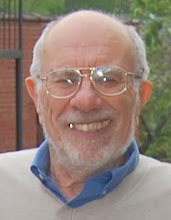
I like to think of myself as a reasonably accomplished man. I am seventy-seven years old. I have raised two fine sons, been a good husband [I hope] to two fine women, written more than a score of books, and taught thousands of students over more than half a century. But when I am faced with elementary clerical tasks that a modestly gifted twelve year old could handle with ease, I melt into a puddle of anxious indecision and become afflicted with terminal incompetence.
At the moment, I am preparing yet another fund raising mailing for my charitable organization, University Scholarships for South African Students. On the letterhead, I call myself the "Executive Director," which seems to imply that there are dutiful minions who do my bidding, but in fact I am the whole show, which means that when it is time to create a mailing, I do it all myself. Writing the letter is elementary; it takes me a comfortable half hour. But then I must begin the tedious, picky task of dividing the data base into eight separate data bases, depending on whether there are two names or one, two addresses or one, and whether I address people formally or by their first names. [I know I am supposed to be able to construct conditional commands that will do all of this seamlessly, but I have never figured out how to make WORD do that.] This is followed by the equally picky jobs of merge printing the envelopes, merge printing the letters, folding, stuffing, and sealing them, and finally stamping them, before putting them all in as many mailboxes as I can find and hoping for the best.
I have been doing this for twenty-one years now, so you would imagine I have long since become good at it. Not on your life! Every time I do it, my blood pressure rises, I break out in sweats, and I make enough mistakes to consume forty or fifty envelopes and letters as throwaways. If I were forced to make my living doing this sort of work, I would seriously consider suicide.
Thank God and Adam Smith for the division of labor.
Wednesday, August 31, 2011


Tuesday, August 30, 2011
THE PHILOSOPHY OF HUME PART THREE
Hume is about to introduce the second component of his theory -- the component in a sense intended to echo Newton -- but first he pauses to distinguish between two faculties of the mind, Memory and Imagination, and in doing so, he reveals some serious, if not fatal, limitations to the simple Copy Theory of Ideas that he has laid out in the opening pages of Book I, Part I. Both Memory and Imagination enable us to call to mind previous perceptions -- in the case of Memory, accurately and in conformity with the sequence and arrangement in which they first presented themselves to us, in the case of Imagination without such limitations, although of course it is still the case that Imagination can call to mind idea-copies only of those simple impressions we have previously experienced. How can we distinguish between things we remember and things we imagine? By the degree of their force and vivacity, Hume replies. The ideas called up by Memory are more lively and strong than those called up by Imagination.
This is pretty clearly the only answer available to Hume, given the elements he has thus far laid down. All impressions and ideas are contents of consciousness, and the only distinctions he can at this point draw with regard to them are whether they are simple or complex and whether they are forceful and vivacious or not. But this answer is manifestly wrong. Everyone has had experience with faded and listless memories, if I may speak in that way, and with lively, forceful, vivid daydreams that are nevertheless plainly the product of Imagination. Hume himself knows this quite well, and elsewhere remarks on the contrast between a dry, lifeless historical account of an event and a vivid, lively fictional account found in a novel. In a bit, I shall indicate how Hume very considerably complicates his story in order to deal with this and many other problems. To anticipate a bit, he is going to have to draw a distinction between the way the mind treats or thinks about or considers ideas that are called up by Memory as contrasted with those called up by Imagination, and this is going to involve talking about activities of the mind, not simply contents of the mind. But first, let us see how Hume introduces the other central element of his theory.
Hume pretty clearly understood Newton to be offering us a theory about a world of material objects, of bodies, connected with one another and interacting with one another by means of a single force, gravity. His big idea, if I may put it that way, was to conceptualize Moral Philosophy as having the same structure. Perceptions -- impressions and ideas -- are the elements, corresponding to Newton's bodies in motion. And as the force connecting them, Hume proposes association. I am going to quote at length the first paragraph of the section entitled "Of the connexion or association of ideas," since Hume says it more clearly and concisely than I can.
"As all simple ideas may be separated by the imagination, and may be united again in what form it pleases, nothing wou'd be more unaccountable than the operations of that faculty, were it not guided by some universal principles, which render it, in some measure, uniform with itself in all times and places. Were ideas entirely loose and unconnected, chance alone wou'd join them; and 'tis impossible the same simple ideas should fall regularly into complex ones (as they commonly do) without some bond of union among them, some associating quality, by which one idea naturally introduces another. This uniting principle among ideas is not to be consider'd as an inseparable connexion; for that has been already excluded from the imagination: nor yet are we to conclude, that without it the mind cannot join two ideas; for nothing is more free than that faculty: but we are only to regard it as a gentle force, which commonly prevails, and is the cause why, among other things, languages so nearly correspond to each other; nature in a manner pointing out to every one those simple ideas, which are most proper to be united into a complex one. The qualities, from which this association arises, and by which the mind is after this manner convey'd from one idea to another. are three, viz. RESEMBLANCE, CONTIGUITY in time or place, and CAUSE and EFFECT."
Let us be clear what Hume is saying. Perceptions flood into our consciousness, of all degrees of vivacity and in endless variety. The mind has the ability to recall them in weakened form as ideas, and to combine them in any way it chooses, either mimicking the order and arrangement with which they entered our minds or arranging them in new and original orders. Nothing compels the mind to recall them in one way rather than another, to be sure. If that were so, then Logic would enable us to deduce a priori which ideas must go with which. But we observe that in fact the recall of impressions or previously apprehend ideas is not entirely random. Rather, certain ideas tend to be recalled together, and upon examination, we find that those ideas are recalled together that resemble one another, or are near to one another in time or place in our original experience of them, or else are connected as cause is to effect. This is not a deduction on Hume's part; it is an observation.
As he is drawing the Section to a close, Hume explicitly draws the analogy to between the "gentle force of association" and the gravitational attraction on which Newtonian physics depends. "Here is a kind of ATTRACTION, which in the mental world will be found to have as extraordinary effects as in the natural, and to shew itself in as many and varied forms." Newton had said, in the Principia, that he eschewed "hypotheses," by which he meant metaphysical speculations about the inner nature of things, contenting himself with exhibiting the laws governing the observable behavior of bodies. Hume echoes that forswearing of speculation, saying of association that "its effects are every where conspicuous; but as to its causes, they are mostly unknown, and must be resolv'd into original qualities of human nature, which I pretend not to explain."
But the parallel Hume seeks to draw between association and gravity is a false one, and a true understanding of what is going on in the Treatise requires that we be clear exactly in what ways the parallel breaks down. Gravity, whatever its sources or inner nature, really does move bodies closer to one another, in ways precisely predicted by Newton's Laws. But association, "gentle force" or no, does not move perceptions closer to one another. It affects the mind, not the perceptions. It is the mind that does the associating. To say that the mind tends to associate fire and heat together is to say that when I see fire, I form the idea of heat. The association is not in the ideas but in the mind.
Unlike Kant, who is quite comfortable talking about Faculties of the Mind -- Understanding, Reason, Imagination, Sensibility, and so forth -- Hume tries very hard not to use the language of Faculty Psychology, but he cannot avoid it, because the very foundation of his theory of knowledge and --as we shall see -- of morals requires him to spell out in considerable detail an account of what the mind does with its perceptual contents. In short, Hume is offering us a Theory of Mental Activity.
The Treatise is chock full of detailed accounts of all manner of mental functionings, but as we shall see, there are really only two big subjects that Hume wishes to tackle in Book I by means of his new theory of association. The first is Causation, and the second is Substance [or Material Objects.] In each case, Hume's discussion begins with a negative or sceptical argument, refuting the claims that philosophers have made about the subject under discussion. That is the part of Hume's text that is best known, although I think it is not the most interesting. After deploying his sceptical arguments, Hume starts again and asks, "Why do we, despite these negative arguments, come to believe that events and objects are causally connected, or to believe that there are independently existing, unified objects that persist through time?" He then gives an original and very imaginative psychological explanation for our beliefs, which, he insists, we are completely unable to give up despite the fact that they have no logical justification whatsoever.
MUSICAL INTERLUDE
Yesterday, after finishing the day's Hume post, I spent several very pleasant hours watching [on my computer, courtesy of Netflix] a 2009 documentary about the life and music of Beethoven. I actually knew very little of the details of Beethoven's life, which were instructive, but it was the music that captivated me. There were extended close-ups of a variety of very accomplished pianists, violinists, cellists, and singers performing extended selections from the entire corpus of Beethoven's work [and also some enchanting moments with Emmanuel Ax at the piano discussing Beethoven's technique and innovations.]
As an amateur violist, I am keenly aware of the simply enormous amount of intense, focused work that is required to achieve a technique sufficient even to raise questions of musical interpretation. A first-rate concert performer does things on a daily basis that are so much harder than anything I have ever done, so much more impressive than anything that a political commentator does, that I am in a condition of perpetual awe and admiration for the men and women who have mastered a classical instrument. The nonsense that one hears on American Idol or at a Rock concert pales into insignificance.
Becoming a Yo-Yo Ma is undoubtedly not open to all of us, but becoming an accomplished professional musician pretty much is, if one is willing to spend six, eight, or ten hours a day for years practicing. Writing a doctoral dissertation is child's play by comparison.
Since moving to Chapel Hill, I have stopped playing. I could not find people to play string quartets with, and simply practicing each day seemed pointless. But there was a time, several years ago, when I could do a creditable job of the viola part in a Haydn, Mozart, or Beethoven quartet. It took me eight years of steady practice and lessons to reach that point [only an hour a day of practice, a mere warm up for a real musician], and I imagine that by now those skills have atrophied. But I did it, and for a while, I really was, in some manner or other, a musician. Writing books is a lot easier, trust me.
As an amateur violist, I am keenly aware of the simply enormous amount of intense, focused work that is required to achieve a technique sufficient even to raise questions of musical interpretation. A first-rate concert performer does things on a daily basis that are so much harder than anything I have ever done, so much more impressive than anything that a political commentator does, that I am in a condition of perpetual awe and admiration for the men and women who have mastered a classical instrument. The nonsense that one hears on American Idol or at a Rock concert pales into insignificance.
Becoming a Yo-Yo Ma is undoubtedly not open to all of us, but becoming an accomplished professional musician pretty much is, if one is willing to spend six, eight, or ten hours a day for years practicing. Writing a doctoral dissertation is child's play by comparison.
Since moving to Chapel Hill, I have stopped playing. I could not find people to play string quartets with, and simply practicing each day seemed pointless. But there was a time, several years ago, when I could do a creditable job of the viola part in a Haydn, Mozart, or Beethoven quartet. It took me eight years of steady practice and lessons to reach that point [only an hour a day of practice, a mere warm up for a real musician], and I imagine that by now those skills have atrophied. But I did it, and for a while, I really was, in some manner or other, a musician. Writing books is a lot easier, trust me.
Monday, August 29, 2011
CORRECTION
The offprint inscribed by me to Henry David Aiken being offered by booksellers is "Kant's Debt to Hume via Beattie," not "Hume's Theory of Mental Activity." Sorry about that.
THE PHILOSOPHY OF HUME PART TWO
It is with keen pleasure and considerable nostalgia that I once again pick up my copy of the Treatise to begin these first segments of the tutorial on the philosophy of David Hume. I first engaged deeply with Hume's thought sixty years ago as a seventeen year old Harvard sophomore, in a course taught by Henry David Aiken and devoted entirely to the Treatise. In my Autobiography, I have told the story of my rather contentious relationship with Aiken [see Volume One, Chapter Two], but eventually he and I were colleagues for three years, and he even invited me to his home for dinner -- a rarity in the socially dysfunctional Harvard Philosophy Department of those years. Yesterday, I was idly Googling myself [let him who is without sin cast the first stone!], and discovered to my astonishment that a rare book seller is offering an "original" copy of my 1960 journal article on Hume, inscribed by me to Aiken, for a mere 120 Euros. Aiken's library must have been sold after he passed away, and somehow that offprint found its way onto the market. When the article appeared, I ordered a hundred offprints, and half a century and more later, I still had about eighty-five of them. When Susie and I sold our Western Massachusetts house and moved to Chapel Hill, I threw out all but three or four of them, thereby, I suppose, inflating their value through enforced scarcity.
In approaching the argument of Book One of the Treatise, it is useful to see Hume as influenced by two major movements in early eighteenth century thought: the so-called "new way of ideas" of John Locke and the dramatic successes in physics culminating in Newton's Principia. Locke's new way of ideas was roughly what I called, in my recently completed introduction to Kant's Critique, the "epistemological turn," which is to say the dissolving of all philosophical questions into an analysis of the contents, cognitive powers, and limitations of the human mind. The triumph of Newton's Principia was in mathematically deriving Galileo's laws of terrestrial motion and Kepler's laws of planetary motion from a single simple set of very general physical laws, thereby decisively refuting the age-old teaching that the heavens and the earth are composed of entirely different sorts of matter and obey entirely different laws. [For those of you who are not familiar with this tradition, the doctrine descending from Aristotle and his Greek predecessors had it that there are four terrestrial substances -- air, earth, fire, and water -- and a fifth substance, or quintessence, finer and purer than the terrestrial substances, of which the heavenly bodies and the spheres in which they are embedded are composed.]
A central point of dispute in the new way of ideas concerned the source or origin of our mental contents -- our "ideas," as Locke called them. Following the line of argument advanced by Plato in the Phaedo and in other dialogues, the Continental Rationalists argued that certain key ideas -- the mathematical ideas, the idea of God, and metaphysical ideas such as substance and accident -- must be innate in the human mind, inasmuch as they could not have been abstracted from sense experience. In opposition to this thesis, Hume embraced wholeheartedly the Empiricist insistence that all of our perceptions derive from sense experience, an insistence that serves as the starting point for both his sceptical and his constructive doctrines. [Hume uses "perception" as Locke used "idea" and as Kant after him used "representation," to mean roughly "mental content," or perhaps, more precisely, "cognitively significant mental content."]
From Newton, Hume took the idea that a single force -- gravitational attraction in the case of physical bodies -- could if properly understood serve to explain the motions of bodies in space. As we shall see, Hume thought he had found the analogue to gravity in the sphere of the mental, and he clearly hoped that he could carry that notion in Moral Philosophy as far as Newton had in Natural Philosophy. Quite the most interesting thing in all of Hume's philosophy, we shall see presently, is the reason why this dream precisely could not be realized.
Hume announces his embrace of the new way in the Introduction to the Treatise. [A warning -- Hume wrote so beautifully, with such concision, clarity, precision, and elegance, that the temptation is overwhelming simply to incorporate large chunks of the Treatise into this tutorial. Any student of philosophy who imagines that it is necessary, or even desirable, to write turgidly and obscurely when engaging with deep questions would do well to spend a long time reading Hume and striving to emulate him.] This passage is from the fifth paragraph of the Introduction:
" 'Tis evident, that all the sciences have a relation, greater or less, to human nature; and that however wide any of them seem to run from it, they will return back by one passage or another. Even Mathematics, Natural Philosophy, and Natural Religion, are in some measure dependent on the science of MAN; since they lie under the cognizance of men, and are judged of by their powers and faculties. 'Tis impossible to tell what changes and improvements we might make in these sciences were we thoroughly acquainted with the extent and force of human understanding, and cou'd explain the nature of the ideas we employ, and of the operations we perform in our reasonings."
The extent and force of human understanding, the nature of the ideas we employ, and the operations we perform in our reasonings -- these, with great concision, delineate Hume's subject in the Treatise. A word of explanation of the term "natural religion." It was common in the eighteenth century to distinguish between religious truths accessible only to those favored with God's direct word, and religious truths available to any person merely by the use of his or her powers of reason. The first were known as "revealed religion," the second as "natural religion." One of the central questions of Western philosophy for the eighteen centuries separating the Incarnation from the publication of the Treatise and the First Critique was the relation between the two.
One further observation that may be of interest to readers before I open the Treatise to page 1 and begin. Hume and his fellow empiricists engendered almost two centuries of what came to be called "sense datum epistemology." But there were a number of difficulties with this way of proceeding that led English philosophers and others in the early twentieth century to turn their attention away from sense contents and toward the language, the words, that we use to describe our sense experience. This came to be called "the linguistic turn," analogously to the "epistemological turn" of a century and a half earlier. Initially, this turn led to a good deal of discussion of "private languages" used to describe subjective and unshareable sense experience, but Wittgenstein and others argued persuasively that language is inherently public and intersubjective, thereby finessing the vexing problem of "other minds." Well, so much for a stroll down memory lane.
"All the perceptions of the human mind resolve themselves into two distinct kinds, which I shall call IMPRESSIONS and ideas. The difference betwixt these consists in the degrees of force and liveliness with which they strike upon the mind. and make their way into our thought or consciousness." Thus the Treatise begins. Right away, the alert reader will feel a certain concern, for whereas impressions [which is to say, colors, sounds, tastes, and so forth, along with passions and emotions such as love, hatred, anger, fear, pleasure, and desire] may seem appropriately described as mere mental contents, or contents of consciousness, ideas, as we customarily understand them, seem to have a referential or intentional structure -- they are, typically, ideas of something. Is that really just a difference in "force and liveliness?" We shall come back to this question in a bit.
Immediately, Hume claims that it is the impressions that are the original contents of our consciousness. Ideas are merely "faint images" of our impressions, or copies of them. Thus is born the so-called "copy theory of ideas." This claim is enormously powerful, because it allows Hume to ask, over and over again with regard to such philosophically problematic ideas as the idea of causal necessity, or the idea of substance, or the idea of God, where the impression is of which the idea in question is a copy. Indeed, this might be called the organizing rhetorical trope of Book One of the Treatise.
Now, Hume introduces two distinctions, one seemingly easy and unproblematic, the other of the greatest importance for his philosophical undertaking. Easy first: some of our impressions are simple, and cannot be divided or separated into parts. A minimally discriminable red patch is an example. Others are complex, such as the variegated expanse of a visual field. The same distinction can be drawn between simple and complex ideas. Every simple idea, Hume insists, is a copy of a simple impression. There are no simple ideas for which there is no corresponding simple impression. But there are many complex ideas that are not copies of any identifiable complex impression, for such ideas are constructed by the mind from the bits and pieces of previous experience, only in new arrangements. So the idea of a Centaur is an idea of a creature with the head and torso of a man [of which we have preceding impressions] and the body of a horse [likewise.] All fictions are generated by the mind's imaginative power to reassemble its simple ideas in new complexes and arrangements.
The other distinction introduced by Hume is between what he calls Impressions of Sensation and Impressions of Reflexion. The latter impressions -- lively and vivacious -- are just like the impressions of sensation, but their origin is different. They do not arise in our minds immediately upon the sense organs being affected by external objects. Instead, there is a two-step process by which they come into being. First, I perceive some object or state of affairs -- for example, the sight of my neighbor dumping his trash on my lawn. I reflect on what I have seen, and there is triggered in me by this act of reflexion a natural internal response, resulting in a new impression of great force and vivacity arising in my consciousness, viz., anger. The passions, Hume asserts, are all impressions of reflexion. What is more, as we shall see, so are our moral feelings, and so most especially is the impression of the necessity of connexion betwixt cause and effect on which Causal Judgments are founded.
Sunday, August 28, 2011
THE PHILOSOPHY OF HUME PART ONE
David Hume was born in Edinburgh in 1711 and died there sixty-five years later. [Old joke among philosophy graduate students: How can you remember the date, 1776, of Hume's death? Answer: It is the same year that Adam Smith published An Inquiry Concerning the Nature and Causes of the Wealth of Nations.] Hume came from what today we would call a middle-class family -- his father was an advocate -- and he never married, supporting himself very modestly by a number of positions as tutor or private secretary, and later by the royalties from his books. He attended Edinburgh University at a very early age -- twelve, or perhaps younger, rather than fourteen, which was the norm. At university, he immediately took to philosophy, eschewing the legal studies which his parents had planned for him. The two great influences on him, as on many young thinkers of that period, were the exciting new physical theories of Newton and others, and the philosophical theories of John Locke, whose Essay Concerning Human Understanding was published in 1690. For anyone interested in the details of Hume's life, I strongly recommend the definitive biography, The Life of David Hume, by E. C. Mossner, which appeared in 1954. There is of course a vast literature on Hume's philosophy, and I shall not even try to comment on it. As I have several times indicated, my own essay on the Treatise can be found at box.net, accessible from this website.
At an astonishingly early age, Hume conceived the idea of writing a full-scale systematic investigation of the cognitive and emotional capacities of the human mind, and he plunged into this work with such intensity that he seems to have come close to a breakdown in his very early twenties. He went to France both to recuperate and to continue his work, there spending some time talking with Jesuit philosophers. While still in his twenties, he brought his efforts to completion in the form of a three volume work entitled A Treatise of Human Nature. The work was published anonymously, the first two volumes in 1739, the third in 1740. The three volumes are entitled "Of the Understanding," "Of the Passions," and "Of Morals" -- roughly speaking epistemology, psychology, and ethics.
The work was not kindly received by reviewers, a fact that Hume felt very, very keenly, inasmuch as he had at that early age committed himself to a life as an author and philosopher. In 1955, newly returned from my European wanderjahr and embarked on the writing of my doctoral dissertation, I amused myself by roaming the stacks of Widener Library at Harvard, pulling down volumes of 18th century English and German literary journals and looking for contemporaneous reviews of the Treatise and the Critique. In the November/December 1939 issue of a journal called A History of the Works of the Learned, I found an anonymous review cited by Mossner and Kemp-Smith of Book I of the Treatise, which had appeared in January of that year. "It was in most ways a review calculated to dissuade the young author from any career connected with the investigation of philosophical problems." [I am here quoting from my own doctoral dissertation.] "Two quotations will suffice to give the tone of the piece:
"... a Man, who has never had the pleasure of reading Mr. Locke's incomparable Essay, will peruse our author with much less Disgust, than those can who have been used to the irresistible Reasoning and wonderful Perspicacity of that admirable writer."
And: "I have afore hinted the mighty value of this Discovery (i.e., "that all our ideas are copied from our impressions"), the Honour of which is intirely due to our Author [the whole review is written in this sarcastic, ironical tone], but it cannot be too often inculcated. I verily think, if it were closely pursued, it would lead us to several inestimable Desiderata, such as the perpetual motion, the grand Elixir, a Dissolvent of the Stone, etc."
I concluded my discussion by remarking that "[t]he entire review proceeds in this manner. Its saving feature is the reasonably accurate, though completely unsympathetic, summary given of the principal doctrines of Book I. On the whole, we can forgive the reviewer who was faced with the impossible task of reading, comprehending, and commenting on one of the great philosophical works of all time, within the short span of ten months after its publication. But this must have been small comfort to the man who wrote late in his life that 'my love of literary fame (was) my ruling passion.' "
Despite his unpromising debut as an author, Hume did in fact achieve very great renown as a writer. Surprisingly, at least to someone like me who knows Hume as a philosopher, far and away his most successful publication was a six volume History of England. I have read long stretches of it and it is, to this modern reader, an utterly tedious recitation of kings, dukes, princes, earls, wars, and dynasties, going all the way back to Roman times, with none of the fascinating economic, social, cultural, or institutional analysis that makes History these days the most accomplished of the humanistic disciplines. But there was in Hume's day nothing at all like it. It can, I think, reasonably claim to be the first major work of British historiography. [Gibbon's Decline and Fall, which is far greater as a work of historiography, did not begin to appear until the year of Hume's death, twenty-years after the History.] Hume also published several very popular collections of essays, in which he discussed a wide range of topics, including economic theory. I shall have something to say about several of them, in particular one elegant essay entitled "Of Miracles." As I have already indicated, Hume also recast the doctrines of the Treatise in two shorter works, the Enquiry Concerning the Human Understanding and the companion Enquiry Concerning the Principles of Morals, but these were not much better received than the Treatise. The Enquiry Concerning the Human Understanding, incidentally, is in several very important regards different from the corresponding passages in the Treatise, and I shall in due course talk about that some.
Hume's other great work, the Dialogues Concerning Natural Religion, was composed by him well before his death. Indeed, he seems to have written drafts of a portion of it as early as 1751. But its doctrines were so likely to give offense to a nation that had an established religion [the Anglican Church] that Hume's friends, among them Adam Smith, prevailed upon him not to publish, and the Dialogues did not appear until his nephew, serving as literary executor, brought it out in 1779, three years after Hume's death. I shall have a good deal to say about the Dialogues after I have finished talking about the Treatise.
Tomorrow I shall launch into a systematic discussion of the Treatise, but I should like first to say a bit more about Hume the man. Not all great philosophers have been admirable human beings [one thinks of Nietzsche, for example, or even of Marx], but Hume was, it seems to me, in every way a truly good man. I should very much like to have had the opportunity to spend an evening in his presence.
It was not, I am afraid, a very imposing presence. Hume had a flabby body and a face very much like a pudding. Mossner's biography has as its frontispiece a 1754 portrait of Hume dressed a la turque, which was then all the style. It is not flattering. By way of contrast, the portrait I have seen of Kant shows him to have been a little man with a pigeon breast and a sharp face. I often think that God got them switched when it came time to match souls with bodies. Kant's little body housed the most powerful mind in Europe, and Hume's great pudding of a body contained a light, agile, quick mind.
Hume was a genial, good-natured man, much beloved of the young ladies, who liked at soirees to sit on his lap and tease him. The French called him le bon David. Trying to imagine what the world looked like to him at these social gatherings, I find myself thinking of Jane Austen and Emily Dickenson, two other powerful, agile, penetrating intellects who seemed to the rest of the world to be inoffensive, and retiring. "I am nobody/ Who are you?" as one of Dickenson's most famous poems begins.
Quite the most famous incident in Hume's generally uneventful life involved Jean-Jacques Rousseau, the Genevois enfant terrible whose Of the Social Contract and Emile electrified intellectual Europe. Hume met Rousseau in Paris, and when Rousseau's revolutionary doctrines made him persona non grata with the ancient regime, Hume undertook to use what little influence he had at the English court to arrange a royal pension for Jean-Jacques. Rousseau came to England, more or less under Hume's sponsorship, and almost immediately [Rousseau was certifiable] formed the paranoid conviction that Hume was secretly plotting against him. Rousseau began to write letters to English literary figures, impugning Hume's character and his literary reputation. Hume was furious. Finally, Rousseau made a mad dash for one of the Channel ports and fled back to France while Hume fumed and all Europe laughed.
It sometimes surprises students that Hume lived much of his life in Edinburgh, rather than relocating permanently to London, but in the middle and later eighteenth century, Scotland was experiencing a literary and intellectual flourishing, often referred to as the "Scottish Renaissance," and though Hume was one of its leading lights, there were many other important figures who had been born in Scotland, including Thomas Reid, Frances Hutcheson, and of course Adam Smith. As I believe I observed during my tutorial on The First Critique, this circle of thinkers had a direct influence on Kant through the intermediation of Scottish merchants who, when they brought their wares to the North Prussian port city of Konigsberg, would inform Kant of the latest intellectual developments in Scotland.
I think that is enough by way of introduction. In the next Part, I shall begin my commentary on the Treatise. If any of you would like to read the Treatise as I proceed, and I urge you to do so, the indispensable edition is by L. A. Selby-Bigge, which includes an extraordinary index, worth the price of the book all by itself.
Saturday, August 27, 2011
WAITING FOR IRENE
The thing about waiting for a hurricane is that there is not much to do but sit and search the skies for indications. One thinks of the greatest hurricane scene in American literature: "The wind came back with triple fury, and put out the light for the last time. They sat in company with the others in other shanties, their eyes straining against crude walls and their souls asking if He meant to measure their puny might against His. They seemed to be staring at the dark, but their eyes were watching God." [Their Eyes Were Watching God, Zora Neale Hurston, 1937, Chapter 18.]
I have filled my bathtub, so that we will have water for the flush toilet if the power goes out. Susie and I brought many of her plants in from the porch, but she is soft-hearted, and when the hummingbirds began fluttering about looking for the missing feeder, she relented and put it back up. Here in Chapel Hill we are on the outer Western fringe of the storm area, so the only threat is that heavy rain will bring down trees in already soaked earth, triggering power outages. I bought some food we can grill, should we be unable to use the gas stove.
To amuse myself, I idly went back over all the writing I have done for my blog since I began posting my Autobiography fourteen months ago. Leaving aside the commentaries on the passing scene, and also setting to one side things I had already written [such as Volume One of the Autobiography, journal articles and speeches, and the unpublished book on deterrence theory from the early 60's], I calculate that in those fourteen months I have written 360,000 words of new material -- Autobiography, tutorials, and so forth. That is the equivalent of four short books, a lot even for me. I have enjoyed the writing enormously, and though some of it has been taxing, taking all in all, it hardly seems to have been a great effort. The hardest part of it all has been wrestling with the computer problems that crop up from time to time.
After mulling it over in my mind, I have decided to undertake a tutorial on the Philosophy of David Hume, even though the core of what I have to say is contained in the journal article I published in 1960 and wrote in the summer of 1956 [when I was twenty-two!] Because that piece was intended for a professional journal, it omitted all of the background and supplementary commentary that readers of this blog might find interesting and useful. In addition, I shall include in the tutorial a discussion of Hume's other great work, the Dialogues Concerning Natural Religion, on which I have never written anything. A word of explanation: Hume considered his two Enquiries his most important works, and many commentators have concurred, but I am very much more partial to the Treatise, which, as I have many times said, is in my judgment the greatest work of philosophy ever written in the English language. [Its only competitor, I would say, is Leviathan by Hobbes.]
I had another idea, which I may yet attempt after the Hume tutorial is ended, viz., an informal discussion of a number of books from different disciplines of which I am especially fond, and which may be not well known to modern readers. But that is for the future.
One cautionary note: in just ten days, Susie and I go to Paris for a short two-week stay. If I have not completed the Hume tutorial when it is time to leave, I will try to continue it from rue Maitre Albert, but the charms of the fifth arrondissement may deduce me away from the life of the mind. We shall see.
I have filled my bathtub, so that we will have water for the flush toilet if the power goes out. Susie and I brought many of her plants in from the porch, but she is soft-hearted, and when the hummingbirds began fluttering about looking for the missing feeder, she relented and put it back up. Here in Chapel Hill we are on the outer Western fringe of the storm area, so the only threat is that heavy rain will bring down trees in already soaked earth, triggering power outages. I bought some food we can grill, should we be unable to use the gas stove.
To amuse myself, I idly went back over all the writing I have done for my blog since I began posting my Autobiography fourteen months ago. Leaving aside the commentaries on the passing scene, and also setting to one side things I had already written [such as Volume One of the Autobiography, journal articles and speeches, and the unpublished book on deterrence theory from the early 60's], I calculate that in those fourteen months I have written 360,000 words of new material -- Autobiography, tutorials, and so forth. That is the equivalent of four short books, a lot even for me. I have enjoyed the writing enormously, and though some of it has been taxing, taking all in all, it hardly seems to have been a great effort. The hardest part of it all has been wrestling with the computer problems that crop up from time to time.
After mulling it over in my mind, I have decided to undertake a tutorial on the Philosophy of David Hume, even though the core of what I have to say is contained in the journal article I published in 1960 and wrote in the summer of 1956 [when I was twenty-two!] Because that piece was intended for a professional journal, it omitted all of the background and supplementary commentary that readers of this blog might find interesting and useful. In addition, I shall include in the tutorial a discussion of Hume's other great work, the Dialogues Concerning Natural Religion, on which I have never written anything. A word of explanation: Hume considered his two Enquiries his most important works, and many commentators have concurred, but I am very much more partial to the Treatise, which, as I have many times said, is in my judgment the greatest work of philosophy ever written in the English language. [Its only competitor, I would say, is Leviathan by Hobbes.]
I had another idea, which I may yet attempt after the Hume tutorial is ended, viz., an informal discussion of a number of books from different disciplines of which I am especially fond, and which may be not well known to modern readers. But that is for the future.
One cautionary note: in just ten days, Susie and I go to Paris for a short two-week stay. If I have not completed the Hume tutorial when it is time to leave, I will try to continue it from rue Maitre Albert, but the charms of the fifth arrondissement may deduce me away from the life of the mind. We shall see.
Subscribe to:
Posts (Atom)