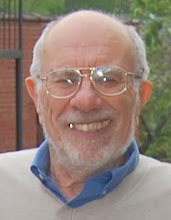
This morning, I stumbled on the blog maintained by retired University of Manchester professor Norman Geras. I do not agree with him in all things [he was a supporter of the war on Iraq, for example], but he writes with wit and verve, virtues all too often absent from the web. Here is the link:
http://normblog.typepad.com/normblog/2010/03/index.html
Thursday, March 15, 2012


Wednesday, March 14, 2012
THE B-MINOR MASS
Yesterday evening, as I mentioned earlier, Susie and I attended a performance at UNC's Memorial Hall of Bach's B Minor Mass, splendidly sung and played by the Amsterdam Baroque Orchestra and Choir led by Ton Koopman. For the two of us, it was very much a stroll down memory lane. Two thirds of a century ago, as teen-agers, we fell in love while listening to the old Robert Shaw recording of the B-Minor Mass. The hall was packed, mostly with UNC faculty, or so it looked. Sitting next to me was the father of a young man who had been a member of the UNC Philosophy Department until he left to go to the CUNY graduate center.
The B-Minor Mass lasts for well over two hours, not counting an intermission about three-quarters of the way through. I had brought Susie's pocket score -- the same one she used in college when she wrote a paper on the piece -- but the lights were too low to follow it, so I put it in my lap and allowed the music to wash over me. The broad, expansive Kyrie gave way to the excited Gloria, with tympani banging and trumpets blaring. The soprano and the tenor did an exquisite job of the Domine Deus, and the bass exhibited a big, rich voice in the Quoniam, although he did tend to bray a bit in the higher passages. Then the chorus returned with the vigorous Cum Sancto Spiritu, bringing the first two parts of the Mass to a close.
By now, a bit more than an hour had passed, and the music was working its spell on me. As the chorus launched into the Credo, something unexpected happened to me. It started with the glorious opening line of the Credo. The tenor section states the subject of the fugue boldly in whole and half notes -- Credo in unum deum -- I believe in one God -- with a moving continuo underneath. Then the basses, the altos, the first sopranos, and finally the second sopranos pick up the subject. I have always loved that moment in the Mass, and I was in fact somewhat disappointed that Koopman chose to have the tenors introduce the subject meditatively rather than triumphantly.
This was followed by the mysterious Et incarnatus est -- and He was made flesh ["incarnated"], which gave way to the exquisitely painful, sad, brooding Crucifixus -- and He was crucified. As the last notes of the Crucifixus died away [passus et supultus est -- suffered, and was buried], the chorus, without a moment's pause, erupted into the exultant cry Et resurrexit -- and He was resurrected. The first trumpeter's face turned beet red as he blew the notes that announce the joyous news.
Et incarnatus est. Crucifixus. Et resurrexit. Here, I thought, is the heart and soul of the extraordinary Christian message. At a single irreplaceable moment in time, the omnipotent, eternal God became flesh. The infinite broke into the finite world, lived and suffered as a mortal man, was scourged, despised, nailed on a cross and left to die; and then, miraculously, rose from the dead and lived again. Just so, through His intermediation, shall we live, die, and yet live again.
I write, you understand, as a life-long atheist, an unbeliever, someone who has never been a communicant of any faith, and who will go to his grave without the consolations of faith. And yet, through the transcendent beauty of Bach's music, I was able to feel the power of the Christian message. A lifetime spent reading philosophical disquisitions about the finite and the infinite, the temporal and the eternal, a lifetime reading Plato and Aristotle, Augustine and Aquinas, Maimonides and Averroes, Luther, Calvin, Kant, and Kierkegaard, combined with a lifetime steeped in the music of Bach, to give me yet again a deep emotional appreciation of the mysteries and wonders of this message that I am utterly incapable of believing.
As I sat in that auditorium, the final sections of the Credo unfolding, a strange, vagrant thought entered my mind, a thought quite unworthy of the moment, and yet impossible to put aside. This extraordinary message, I reflected, is presented to Rick Santorum in its impenetrable mystery, and yet all that impoverished, vulgar, cheap little man can think is that it is all about sex -- about who is giving pleasure to whom, and how, and where, with or without protection. Offered a vision of eternal life, the dirty little mind of this wretched homunculus turns to "man on dog."
It occurred to me -- and I say this as a confirmed atheist -- that what is wrong with American politics is not that Christianists have brought religion into the public space. What is wrong with American politics is the debased, diminished, soulless, conception of religion they have brought. These are trivial men and women, vulgar, ignorant men and women, men and women who have never felt the least tingle of divinity and would not know what to do with it if they did.
Perhaps it is just as well that i do not listen to the B-Minor Mass too often.
Monday, March 12, 2012
THE VAGARIES OF POLLING DATA
A new poll, released today, reveals that half of the Republican voters in Mississippi and Alabama think Obama is a Muslim, and 60% reject the theory of evolution. Since I have almost no hair left, tearing my hair out is not an option. Instead, I find myself harking back to an old journal article, published more than half a century ago, by the late David Riesman. Riesman, as my younger readers may not know, was a prominent sociologist who was trained as a lawyer at Harvard, clerked for Brandeis on the Supreme Court, and after teaching law at Buffalo, joined the Harvard faculty in the Social Relations Department during the time that I was an Instructor there [i.e., in the late '50s.]. Riesman was best known for his book, The Lonely Crowd, in which, among other things, he coined the personality category terms "inner directed," "tradition directed," and "other directed."
The article in question was Riesman's attempt to explain the wide and very rapid swings in the views expressed by subjects in the then rather new genre of opinion polling. He was puzzled by the fact that, for example, 70% of Americans might express the opinion one week that Red China should be admitted to the UN, and 65% would express the contrary opinion a week later. How could people change their minds so dramatically, so quickly?
Riesman suggested that what was at work was not opinion change but something more akin to status anxiety. When a pollster came to the door [this was before telephone calling was the sole method of polling], nicely dressed, wearing a coat and tie, and carrying an official looking clipboard, the person answering the door probably felt somewhat intimidated, and was embarrassed to confess that he or she had no opinion at all about something that was apparently important to this obviously socially upscale person. Rather than admit to having no opinion, the person would more than likely seize on whatever he or she had heard on the radio or seen on the telly that day, and offer as a settled opinion what was actually anything but.
Surely something akin to this is going on here. Do the people being polled have a considered opinion about the theory of evolution? Do they have any idea at all what the theory of evolution asserts? Of course not. What they do know is that smart-ass stuck-up Northern irreligious liberals "believe in": evolution, so they don't. Do they actually know what it is to "be a Muslim?" Probably not. But they know that Muslims are not like us, and Obama is clearly not like us, so called upon to offer an opinion, they say Obama is a Muslim.
The thing that drives me wild about all of this is that these people use IPhones and IPads, are on FaceBook, get flu shots, opt for radiation therapy when they get cancer, and do all the other things that presuppose the truth of the science that they mindlessly reject. It is a measure of my desperation and mean-spiritedness that I daydream about denying them treatment unless they sign a statement asserting that they accept the science on which the treatment is based.
It is going to be a long Spring, Summer, and Fall.
The article in question was Riesman's attempt to explain the wide and very rapid swings in the views expressed by subjects in the then rather new genre of opinion polling. He was puzzled by the fact that, for example, 70% of Americans might express the opinion one week that Red China should be admitted to the UN, and 65% would express the contrary opinion a week later. How could people change their minds so dramatically, so quickly?
Riesman suggested that what was at work was not opinion change but something more akin to status anxiety. When a pollster came to the door [this was before telephone calling was the sole method of polling], nicely dressed, wearing a coat and tie, and carrying an official looking clipboard, the person answering the door probably felt somewhat intimidated, and was embarrassed to confess that he or she had no opinion at all about something that was apparently important to this obviously socially upscale person. Rather than admit to having no opinion, the person would more than likely seize on whatever he or she had heard on the radio or seen on the telly that day, and offer as a settled opinion what was actually anything but.
Surely something akin to this is going on here. Do the people being polled have a considered opinion about the theory of evolution? Do they have any idea at all what the theory of evolution asserts? Of course not. What they do know is that smart-ass stuck-up Northern irreligious liberals "believe in": evolution, so they don't. Do they actually know what it is to "be a Muslim?" Probably not. But they know that Muslims are not like us, and Obama is clearly not like us, so called upon to offer an opinion, they say Obama is a Muslim.
The thing that drives me wild about all of this is that these people use IPhones and IPads, are on FaceBook, get flu shots, opt for radiation therapy when they get cancer, and do all the other things that presuppose the truth of the science that they mindlessly reject. It is a measure of my desperation and mean-spiritedness that I daydream about denying them treatment unless they sign a statement asserting that they accept the science on which the treatment is based.
It is going to be a long Spring, Summer, and Fall.
COMING FULL CIRCLE
In 1948, when I was fourteen, I fell in love with Susie. On occasion, I would walk her home from school, and we would listen to Bach's B Minor Mass on old 78 rpm records, with one of those new-fangled players that had an automatic changer, so that you could load up a stack of 78s and sit back. The recording was by Robert Shaw conducting the Collegiate Choral. Tomorrow evening, sixty-four years later, we shall hear a performance at UNC of the B Minor Mass with Ton Koopman and the Amsterdam Baroque Orchestra and Choir. There is a certain metaphysical unity to our lives, I like to think.
Saturday, March 10, 2012
SHAMELESS FAMILY PROMOTION DEPARTMENT
My son, Professor Tobias Barrington Wolff, has just published an extraordinarily interesting article, which I was privileged to read in manuscript, as it were, when he completed it. It is called "Civil Rights Reform and the Body," and can be accessed by cutting and pasting this link:
http://papers.ssrn.com/sol3/papers.cfm?abstract_id=2019632&
What makes the essay so interesting, to my way of thinking, is his ability to bring into fruitful conjunction materials from a diversity of academic fields [I like to believe that he got a little bit of this from me, but then, as a father, I of course take credit for what my sons do.] In addition to his groundbreaking work on LGBT legal rights, Tobias is the leading young Civil Proceduralist in the academic legal community.
Quite the most fascinating part of the essay is the section in which he talks about the early stages of train travel in America. That is worth the price of the entire article all by itself.
http://papers.ssrn.com/sol3/papers.cfm?abstract_id=2019632&
What makes the essay so interesting, to my way of thinking, is his ability to bring into fruitful conjunction materials from a diversity of academic fields [I like to believe that he got a little bit of this from me, but then, as a father, I of course take credit for what my sons do.] In addition to his groundbreaking work on LGBT legal rights, Tobias is the leading young Civil Proceduralist in the academic legal community.
Quite the most fascinating part of the essay is the section in which he talks about the early stages of train travel in America. That is worth the price of the entire article all by itself.
DERRICK BELL
I don't know that it makes any difference, but in light of the phony "controversy" generated from the grave by the late and totally unlamented Andrew Breitbart, I think I ought to say at least a word about the late and very much lamented Derrick Bell. I did not know Bell well, but I had enormous respect and admiration for him, both for his scholarly writings and for his courageous stand at Harvard Law School against their failure to hire a Black woman to the faculty. Bell, you may recall, with an ironic wit that I thought was simply off the charts marvelous, once staged a "sit-in" at Harvard Law School, announcing that he would not leave his own office [!!!], to protest the failure of the Law School to tenure a Black woman. He thereby skewered his colleagues, who were notorious for being everywhere in the world save in their offices available to students. [Some time later, the Law School decided that its faculty were not spending enough time with students, so they set out to raise four hundred million dollars to hire some new faculty for the purpose -- I am not making this up.]
Eventually, Bell took an unpaid leave, saying that he would not return until Harvard tenured a Black woman in the Law School. I was at UMass at the time, and I was simply outraged at the complete failure of his "radical" fellow Critical Legal Theorists at Harvard to make any sort of public fuss about all of this. So I sent him a check for a thousand dollars to help tide him over until he got another gig. [This was, on my part, more or less the act of a parochial boob, since Bell, at his resignation, was probably making two or three times my salary, but at least it was well intentioned.] He responded in a very sweet letter, and told me he had donated the money to a fund that had been set up to honor his wife, who had passed away rather tragically a short time earlier. He and I stayed in touch, on and off, and I actually had the pleasure of meeting him on at least one occasion.
The big controversy, by the way, consists of a video of Obama, then President of the Harvard Law Review, introducing Bell at a rally in Bell's support [and hugging him, horror of horrors.] I was unaware of this fact, and needless to say, consider it one of the best things I have ever heard about Obama.
God, this is a really screwed up country.
Eventually, Bell took an unpaid leave, saying that he would not return until Harvard tenured a Black woman in the Law School. I was at UMass at the time, and I was simply outraged at the complete failure of his "radical" fellow Critical Legal Theorists at Harvard to make any sort of public fuss about all of this. So I sent him a check for a thousand dollars to help tide him over until he got another gig. [This was, on my part, more or less the act of a parochial boob, since Bell, at his resignation, was probably making two or three times my salary, but at least it was well intentioned.] He responded in a very sweet letter, and told me he had donated the money to a fund that had been set up to honor his wife, who had passed away rather tragically a short time earlier. He and I stayed in touch, on and off, and I actually had the pleasure of meeting him on at least one occasion.
The big controversy, by the way, consists of a video of Obama, then President of the Harvard Law Review, introducing Bell at a rally in Bell's support [and hugging him, horror of horrors.] I was unaware of this fact, and needless to say, consider it one of the best things I have ever heard about Obama.
God, this is a really screwed up country.
THE CW OF THE MSM
The retirement announcement of the soon to be late and already unlamented Olympia Snowe has predictably unleashed yet another tsunami of punditry by the usual suspects about the regrettable rigidity of today's Congressional Democrats and Republicans. This has been coupled with bathetic nostalgia for the good old days when giants of accommodation walked the halls of Congress, regularly reaching out across the aisles to craft compromises in the sacred middle of the political spectrum. This, I believe, is what is referred to in those compressed fragments of communication called tweets as the CW of the MSM. Those of us with pretentions to a somewhat better class of education prefer the phrase consensus gentium, believing, as we do, that it always sounds better in Latin.
Never mind the false and self-serving claim that the ideological rigidity of those on the right is mirrored by a like rigidity of the few remaining Members of Congress who can plausibly be described as "on the left." Rachel Maddow has nicely skewered that fiction. [I leave it to someone more agile at these things than I to provide the link in a comment.] I should like to call into question the central thesis, namely that the vanishing breed of "moderates" like Snowe [and her colleague with the extraordinarily irritating voice, Susan Collins] are more open-minded, more flexible, more willing to engage in the quintessentially democratic act of compromise, than their more inflexible colleagues to the right or the left.
What follows is an hypothesis, not a thesis, because I do not have hard data to support it. But I would be happy to put money on the proposition [not a Romneyesque ten thousand, to be sure, but certainly a fiver], because I am sure its central idea is correct.
Let us choose a single very large and complex issue of public policy -- health care reform, say, since we all remember the debates and maneuverings that led to the passage of the Affordable Care Act [also known, to Republicans, as Obamacare, and to some candidates for the Republican presidential nomination as Obamneycare]. In a leap of conceptual simplification worthy of a neo-classical economist, let us suppose that all the many possible positions, pro and con, on health care reform can be arrayed along a one-dimensional spectrum from left to right. We may imagine that at the extreme left is true socialized medicine, with no insurance companies, no for-profit hospitals, and the central government paying the entire bill from the general tax fund. Somewhat to the right of that terminus, but still situated well to the left, is a single payer version of the current health care system. The extreme right, we may suppose, is represented by the position of Dr. [and Congressman] Ron Paul, who says that uninsured trauma patients who show up in the Emergency Room of a for-profit hospital should be left to die -- rather like the old nineteenth century practice of letting a house burn if it did not sport a plaque showing that the owner was a subscriber to the private firefighting service. [Those plaques, incidentally, are now valuable collector's items of Americana.]
Each member of the House or Senate, we shall now assume, can identify some point on that spectrum of positions that corresponds to his or her ideologically most preferred policy -- some complicated combination of coverages and exclusions, guarantees and options, in the maelstrom of the American health care system. Now I am going to make a really serious conceptual simplification, genuinely worthy of a General Equilibrium theorist. I am going to assume that each person, having located himself or herself at some point on the line, finds that each position to the left is less acceptable, the farther to the left it is from that point, and that each position to the right is also less acceptable, the farther to the right it is from that point. [Those who have actually read my Tutorial on the use and abuse of formal models in political theory will recognize this simplification from the work of the Australian political scientist Duncan Black, but that, as they say, was in another land, and besides the wench is dead.]
OK. Got that? A line the points of which are different health care reform positions, arrayed from left to right, and Members of the House and Senate positioned along that line, looking with increasing disfavor to positions to their left or right according to how much farther right or left they are. Let us suppose the line looks like this:
___________________________________________
Now, imagine some senator positioned somewhere along the line -- to the right, let us say. Let us invent a name for him, a name so absurd and comical that no actual senator could ever actually bear it. I know, how about Jefferson Beauregard Sessions III, or Jeff Sessions, for short? Let us suppose that Jeff Sessions is positioned, on the issue of health care reform, like this:
__________________________________JF________
Jeff Sessions, we assume, prefers the package of health care reform proposals identified by the point on the line where we have located his initials, and if he had the power to enact a bill, that is exactly the bill he would choose. But I am betting [this is where the hypothetical part of all of this comes into play] that he would be willing to compromise to at least some extent to get most of what he wants, striking a deal with Jim DeMint to his right or Jon Kyl slightly to his left [but still securely within the conservative segment of the line, of course.] I may be wrong, of course. Maybe Jeff Sessions is totally and immovably inflexible on the issue of health care reform. But I would bet more than a fiver that that is not so. Recall our assumption that the various positions are less and less acceptable to anyone located anywhere on the line the farther away they are, to the left or the right, from where he or she is located. It follows from this assumption [never mind the proof, if it isn't obvious] that there is a compact space of possible positions around Jeff Sessions, all of which would be acceptable to him in a compromise, if he were able to get one. Let us suppose this situation looks like this:
______________________________(___JF____)_____
Presumably, every single Senator and Representative can be modeled on the line in the same fashion. Some will have very wide brackets around their initials, some very narrow brackets. The width of the bracket, in this little model, is a visible representation of that politician's flexibility, or willingness to compromise.
Now, my hypothetical thesis is this: the people located near the break between the Democratic [left] side and the Republican [right] side of the line, people like Olympia Snowe, do not in general have brackets around their initials that are noticeably wider than the brackets around the initials of people located near the left end or the right end of the line. But because they are more often in play when one side or the other is attempting to assemble a winning coalition, they acquire the undeserved reputation for being reasonable, willing to compromise, non-ideological, or public-spirited.
I watched the very public wooing of Olympia Snowe during the health care debate, and it was my distinct impression that she had an extremely narrow bracket around her initials [so to speak]. She just happened to be located at the fault line between the two parties. My informal guess is that the most flexible members of the Senate were actually the most liberal Democrats, who were willing to make enormous compromises to get something, anything, done.
There is of course not the slightest possibility that anyone in the MSM will take note of this, or will adjust the CW by so much as a micrometer. That would require intelligence and the willingness to consider a new idea.
Subscribe to:
Posts (Atom)