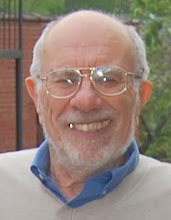
The counter at the top of this blog tells me that people have come to this site a total of something over half a million times. This is, of course, nothing at all for any of the popular blogs and websites, but it is one hundred times as many students as passed through my classes in half a century. I am delighted that so many folks around the world have stopped by, and I hope they will continue to do so. My work at Bennett College has forced me to post less often, and also to put up shorter posts -- that and the fact that I may be running out of things to say!
We are now three weeks from the election. I am in a state of perpetual anxiety, I must confess, which will either be eased or turned into deep gloom by the outcome. I have been trained, as a philosopher, to view things sub specie aeternitatis, but the flesh is weak.
At all events, thank you for visiting, and do come back.
Monday, October 15, 2012


Sunday, October 14, 2012
I DWELL IN POSSIBILITY [DICKINSON]
Yesterday, after a ten day catastrophic collapse, Nate Silver's chart took a tiny, almost imperceptible, tick up. Like a drowning sailor clutching at driftwood, I seize upon it and allow myself, if not hope, at least sleep. As my son says, "I would still rather be us rather than them." Thank the Lord for Joe Biden. The demographics being what they are, and the craziness of the Republicans apparently incurable, I continue to believe that if we can squeak past November 6th, we may yet see a rebirth of progressive politics in America of a sort that has not been evident since the glory days of Roosevelt. There are many Elizabeth Warrens out there, and some of them, she included, could well be elected in this cycle.
Meanwhile, I struggle with the endless challenges of Bennett College, where I can almost see my efforts having some discernible effect.
On a much, much happier note, yesterday I bought my grandson a baseball mitt, baseball bat, and big league for-real baseball, all of this in anticipation of a November trip to San Francisco to see my son, daughter-in-law, and grandchildren. Samuel is now a confirmed baseball fan, although I am not certain whether it is the game or the statistics he really loves. Gender role typing still lives, despite the best efforts of liberated parents. Four year old Athena wants a Cindarella costume and doll for Christmas. My guess is that when she is the CEO of a not-for-profit international charitable organization, she will still be dressing up.
Meanwhile, I struggle with the endless challenges of Bennett College, where I can almost see my efforts having some discernible effect.
On a much, much happier note, yesterday I bought my grandson a baseball mitt, baseball bat, and big league for-real baseball, all of this in anticipation of a November trip to San Francisco to see my son, daughter-in-law, and grandchildren. Samuel is now a confirmed baseball fan, although I am not certain whether it is the game or the statistics he really loves. Gender role typing still lives, despite the best efforts of liberated parents. Four year old Athena wants a Cindarella costume and doll for Christmas. My guess is that when she is the CEO of a not-for-profit international charitable organization, she will still be dressing up.
Friday, October 12, 2012
ADVERTISEMENTS FOR MYSELF [WITH APOLOGIES TO NORMAN MAILER]
By the way, did I ever tell you about the one time I actually saw Norman Mailer? It was at a very chi-chi Upper West Side type intellectual gathering called "The Theater for Ideas" held in a ballet studio in the Village. I was brought along by Bob Silver, the editor of the New York Review of Books, whom I had met through Bob Heilbroner -- this was back in my Columbia days, the late Sixties. Everyone was there -- Mailer, Susan Sontag, William Schuman, Sidney Hook, et al., for a symposium on "The Hidden Philosophy of Psychoanalysis," with Sidney Morgenbesser and Bruno Bettelheim among the speakers. In the question period, Mailer got up -- a bantam cock in suit and vest -- and proceeded to deliver an interminable attack on his current psychiatrist, to everyone's great amusement.
Anyway, that is just me digressing, like Tristram Shandy. The point of this post is that every so often I remember that not everyone in the literate world has read every word I have posted on this blog. There are a few hardy souls who have read all of the instalments of my eight hundred page "Memoir," day by day as it appeared, and I imagine there may even be someone out there who stuck with me through my tutorial on The Thought of Karl Marx. But there really is a lot of stuff that I have posted here -- more than 500,000 words of serious extended essays, leaving to one side the ephemera devoted to snarking and bitching or idle reminiscing.
If there are any folks in the cyberworld who would like a tutorial on Max Weber's Protestant Ethic and the Spirit of Capitalism, or on The Thought of Sigmund Freud, or who might enjoy essays, tutorials, mini-tutorials, and Appreciations on any of perhaps two dozen other topics, all they need do is follow the link at the top of this blog to box.net, and rummage about. The free version of box.net, which I employ, used to actually tell me how many people have taken a look at each of the items posted there. When they stopped doing that [since I do not pay them anything], more than six hundred people had accessed the Marx tutorial, and there were quite a number who had taken a look at one or another of the other items. Very satisfying for an author. Not quite J. D. Salinger territory, but we philosophers are used to whispering in a corner with a few boys [and girls, these days], as Callicles says in the Gorgias.
Anyway, that is just me digressing, like Tristram Shandy. The point of this post is that every so often I remember that not everyone in the literate world has read every word I have posted on this blog. There are a few hardy souls who have read all of the instalments of my eight hundred page "Memoir," day by day as it appeared, and I imagine there may even be someone out there who stuck with me through my tutorial on The Thought of Karl Marx. But there really is a lot of stuff that I have posted here -- more than 500,000 words of serious extended essays, leaving to one side the ephemera devoted to snarking and bitching or idle reminiscing.
If there are any folks in the cyberworld who would like a tutorial on Max Weber's Protestant Ethic and the Spirit of Capitalism, or on The Thought of Sigmund Freud, or who might enjoy essays, tutorials, mini-tutorials, and Appreciations on any of perhaps two dozen other topics, all they need do is follow the link at the top of this blog to box.net, and rummage about. The free version of box.net, which I employ, used to actually tell me how many people have taken a look at each of the items posted there. When they stopped doing that [since I do not pay them anything], more than six hundred people had accessed the Marx tutorial, and there were quite a number who had taken a look at one or another of the other items. Very satisfying for an author. Not quite J. D. Salinger territory, but we philosophers are used to whispering in a corner with a few boys [and girls, these days], as Callicles says in the Gorgias.
Thursday, October 11, 2012
A FITTING TRIBUTE
Regular readers may recall that on August 17th last, I posted a tribute to an old friend, Hugo A. Bedau, who passed away at the age of 85. Like many scholars of an earlier era, Hugo amassed over the years a number of complete runs of philosophy journals in his fields of interest. His widow, Constance Putnam, a scholar in her own right, has now very generously donated Hugo's complete library of philosophy journals to Bennett College. On Tuesday, I took the last set of boxes out to Greensboro and transferred them to the Bennett College library. Young people being what they are, I have no idea how many of them will actually consult a physical journal, as opposed to finding an article on-line, but I like to think that now and then, a young woman interested in ethical theory or political philosophy will go to the library and find there Hugo's journals, which she can pick up, hold in her hand, and page through in the old way.
I have very powerful sensory associations with specific books and journals. The Journal of Philosophy feels and smells very different from Mind, and neither of them is quite like Ethics, which always seemed to me physically pedestrian [even though I did publish in it at least once, if memory serves.] One of my favorite physical books is my stubby black copy of Hume's Treatise, edited by Selby-Bigge. The row of Oxford University Press translations of the works of Aristotle, sitting high on my shelves here in my study, breathes of England.
All of this is hideously retro, I know. I am sure there were many late Renaissance monks, fingers stained from the ink of their endless copying chores, who looked askance at printing presses. But then, there must have been reflective Neanderthals who scoffed at the new-fangled bows and arrows of their high-domed, gracile Cro Magnon neighbors.
I have very powerful sensory associations with specific books and journals. The Journal of Philosophy feels and smells very different from Mind, and neither of them is quite like Ethics, which always seemed to me physically pedestrian [even though I did publish in it at least once, if memory serves.] One of my favorite physical books is my stubby black copy of Hume's Treatise, edited by Selby-Bigge. The row of Oxford University Press translations of the works of Aristotle, sitting high on my shelves here in my study, breathes of England.
All of this is hideously retro, I know. I am sure there were many late Renaissance monks, fingers stained from the ink of their endless copying chores, who looked askance at printing presses. But then, there must have been reflective Neanderthals who scoffed at the new-fangled bows and arrows of their high-domed, gracile Cro Magnon neighbors.
WHAT AM I READING?
My big sister, Barbara, who is not only older than I but much wiser, decided that I needed a book to read as a way of taking my mind off Obama's plummeting poll numbers, so she suggested three or four things [she is an insatiable reader], and I chose Sam Kean's The Violinist's Thumb, and other tales of love, war, and genius, as written by our genetic code. Faithful Amazon.com delivered it almost immediately, and I am now more than a hundred pages into it.
Kean is not a practicing evolutionary biologist [Barbara, who knows an enormous amount about such things, tells me that on occasion he gets the genetics wrong], but he has a magpie mind that has collected up an astonishing array of stories, gossip, scandals, and fascinating tidbits to go with his very engagingly expounded genetics. The result is a simply delightful book, which I recommend to all of you.
One chapter in particular quite unexpectedly hit very close to home, the chapter devoted to the great early twentieth century geneticist Thomas Hunt Morgan and his research assistants. Hunt won the Nobel prize for his work, which focused on the common fruit fly, drosophila. [Fruit flies were the perfect objects of study by early geneticists because they have unusually large chromosomes, which could be seen rather clearly with the microscopes of the day.]
What did all of this have to do with the Wolff family? Well, my father, Walter, after graduating from C.C.N.Y. in 1923, went to Columbia [a short bus ride down Amsterdam Avenue] to do an M. A. in Biology. He dreamed of getting a doctorate, but since he was by then married to my mother, he left school and began a career as a biology teacher in the New York City high schools. With whom did he study at Columbia? Yup. Thomas Hunt Morgan.
The basement of our little house in Queens, which my father himself finished into a rec room, had an old microscope and several boxes of slides in it. Barbara and I would peer through the monocular scope at stained slides of all manner of stuff. In high school, first Barbara and then I studied Biology with Paul Brandwein [Dr. Paul Brandwein, as we were reminded], who had at one point been a teacher in the High School Biology Department chaired by my father. Brandwein seized on the newly established national competition called, after its sponsor, the Westinghouse Science Talent Search [now the Intel Science Talent Search], and pushed his very best seniors into entering the competition. Students had to take a written exam on science and do an original research project. The forty best competitors were brought to Washington D. C. for a week, where one boy and one girl [as they were then referred to] were selected as grand national winners. Each of them got a $2400 college scholarship, which in those days was enough to pay four years of tuition [eat your hearts out, young people!]
My sister chose to study a species of fruit fly -- drosophila melanagaster. She produced in them phenocopies -- bodily changes [eye color and such] that mimicked mutations, but were induced by shining a special light on them. Bobs did her research in the basement, but as all of us have found, fruit flies are pesky critters with no sense of decorum, and every evening at the family dinner table a little cloud of migrants from the basement would hover over our meal.
Sure enough, Barbara was the grand national girl winner her year. I even got into the act, because Barbara was supposed to make a presentation of her research at a New York science fair on the same day that Swarthmore had scheduled her for an on-campus interview. So little Robby put on some presentable clothes and stood in for her, speaking knowledgeably about something he knew almost nothing about [a harbinger of my eventual career, I fear.]
I knew all of this from childhood, but until I read Kean's chapter on Hunt, I had never put it all together in my mind. I felt, as I went through the chapter, as though I were reading our family history.
Kean is not a practicing evolutionary biologist [Barbara, who knows an enormous amount about such things, tells me that on occasion he gets the genetics wrong], but he has a magpie mind that has collected up an astonishing array of stories, gossip, scandals, and fascinating tidbits to go with his very engagingly expounded genetics. The result is a simply delightful book, which I recommend to all of you.
One chapter in particular quite unexpectedly hit very close to home, the chapter devoted to the great early twentieth century geneticist Thomas Hunt Morgan and his research assistants. Hunt won the Nobel prize for his work, which focused on the common fruit fly, drosophila. [Fruit flies were the perfect objects of study by early geneticists because they have unusually large chromosomes, which could be seen rather clearly with the microscopes of the day.]
What did all of this have to do with the Wolff family? Well, my father, Walter, after graduating from C.C.N.Y. in 1923, went to Columbia [a short bus ride down Amsterdam Avenue] to do an M. A. in Biology. He dreamed of getting a doctorate, but since he was by then married to my mother, he left school and began a career as a biology teacher in the New York City high schools. With whom did he study at Columbia? Yup. Thomas Hunt Morgan.
The basement of our little house in Queens, which my father himself finished into a rec room, had an old microscope and several boxes of slides in it. Barbara and I would peer through the monocular scope at stained slides of all manner of stuff. In high school, first Barbara and then I studied Biology with Paul Brandwein [Dr. Paul Brandwein, as we were reminded], who had at one point been a teacher in the High School Biology Department chaired by my father. Brandwein seized on the newly established national competition called, after its sponsor, the Westinghouse Science Talent Search [now the Intel Science Talent Search], and pushed his very best seniors into entering the competition. Students had to take a written exam on science and do an original research project. The forty best competitors were brought to Washington D. C. for a week, where one boy and one girl [as they were then referred to] were selected as grand national winners. Each of them got a $2400 college scholarship, which in those days was enough to pay four years of tuition [eat your hearts out, young people!]
My sister chose to study a species of fruit fly -- drosophila melanagaster. She produced in them phenocopies -- bodily changes [eye color and such] that mimicked mutations, but were induced by shining a special light on them. Bobs did her research in the basement, but as all of us have found, fruit flies are pesky critters with no sense of decorum, and every evening at the family dinner table a little cloud of migrants from the basement would hover over our meal.
Sure enough, Barbara was the grand national girl winner her year. I even got into the act, because Barbara was supposed to make a presentation of her research at a New York science fair on the same day that Swarthmore had scheduled her for an on-campus interview. So little Robby put on some presentable clothes and stood in for her, speaking knowledgeably about something he knew almost nothing about [a harbinger of my eventual career, I fear.]
I knew all of this from childhood, but until I read Kean's chapter on Hunt, I had never put it all together in my mind. I felt, as I went through the chapter, as though I were reading our family history.
Wednesday, October 10, 2012
HOW SHARPER THAN A SERPENT'S TOOTH
I grew up in a tiny row house in Queens. My room, the smallest in the house, was just large enough for a bed, a little dresser, and a table next to the bed, on which sat a little radio. At night, sometimes, I would lie in the dark and listen to the Dodgers baseball games. I was a rabid fan, even going once or twice to Ebbets Field for a game. I didn't know that Dixie Walker was a racist pig, just that he was a hell of an outfielder. I would cheer as Eddie Stanky, the Walkin' Man, would foul off pitch after pitch until he drew that fourth ball. I was true to them until I went off to college, but I never transferred my allegiance to the Red Sox. My passion for the game just cooled [although I did ride in a nearly deserted club car of the Shore Line train from New York to Boston with Ted Williams at the other end of the car -- I did not disturb the great man, of course.]
Christmas is approaching, so so I sent an email to my daughter-in-law, Diana, to ask what the grandchildren would like for presents. Samuel's seventh birthday is December 22nd, and having myself been born on December 27th, I know what it is like to get "one big present for both Christmas and Birthday" -- never, I was convinced, as good as what my sister got for being born in August. So I try to make sure that I find something for Samuel's birthday and something totally different for him for Christmas.
Well, Samuel lives with his father and mother and sister in San Francisco, and apparently, having finished with the phase in which he was fascinated by cell phones and the phase in which he was fascinated by button operated crossing lights, and having gotten over his brief fling with chess [always a questionable idea for him, since his father is a famous International Grandmaster], Samuel now decided that he is a baseball fan.
All well and good, and quintessentially American, except that it is the Giants who now play in San Francisco, so Samuel of course is a Giants fan. He does not know that seventy years ago, when his grandfather was his age, the L. A. Dodgers played in Brooklyn, and that it just a little bit breaks his grandfather's heart that he is a Giants fan.
How sharper than a serpent's tooth ...
Christmas is approaching, so so I sent an email to my daughter-in-law, Diana, to ask what the grandchildren would like for presents. Samuel's seventh birthday is December 22nd, and having myself been born on December 27th, I know what it is like to get "one big present for both Christmas and Birthday" -- never, I was convinced, as good as what my sister got for being born in August. So I try to make sure that I find something for Samuel's birthday and something totally different for him for Christmas.
Well, Samuel lives with his father and mother and sister in San Francisco, and apparently, having finished with the phase in which he was fascinated by cell phones and the phase in which he was fascinated by button operated crossing lights, and having gotten over his brief fling with chess [always a questionable idea for him, since his father is a famous International Grandmaster], Samuel now decided that he is a baseball fan.
All well and good, and quintessentially American, except that it is the Giants who now play in San Francisco, so Samuel of course is a Giants fan. He does not know that seventy years ago, when his grandfather was his age, the L. A. Dodgers played in Brooklyn, and that it just a little bit breaks his grandfather's heart that he is a Giants fan.
How sharper than a serpent's tooth ...
Tuesday, October 9, 2012
THE SECRET OF MY SUCCESS
In 1951 or 1952, when I
was an undergraduate at Harvard, the great American poet and biographer of
Lincoln, Carl Sandburg, came to give a lecture.
Sandburg, who lived to be 89, was then in his seventies, and of course
looked absolutely ancient to us. He was
a true poet of working people, back when America still acknowledged the
existence of a working class. He told a
story that has stayed with me ever since.
It seems, Sandburg said,
that there were two cockroach brothers perched on a farmer's cart riding into
town one day. The cart hit a bump in the
town's main street, and the two cockroaches fell off. One brother fell onto a heap of dung -- very
heaven for a cockroach -- and waxed fat and shiny. The other brother fell into a storm drain and
nearly drowned. Slowly, laboriously, the
second brother pulled himself up out of the drain until, exhausted, emaciated,
near death, he dragged himself back into the gutter. As he looked up, he saw his brother seated
happily atop the dung heap, sunning himself.
"Brother," the unhappy cockroach cried, "how have you become
so fat and happy?" The fat
self-satisfied cockroach looked down at his miserable relative and said,
smugly, "Brains, and hard work."
I think of this story
often as I reflect on the ease and endless rewards of my career, moving from
comfortable position to comfortable position, and compare it with the terrible
struggles of young academics trying to gain some sort of security and time for
their own scholarship in an increasingly hostile job market. The sixties, when my career was being
launched, was a time of explosive growth of higher education in America. Spurred by the G. I. Bill and the post-war
economic boom, and fed by an endless stream of young men avoiding the Viet Nam
draft, colleges and universities virtually metastasized. State universities, which had existed ever
since the Land Grant Acts of the 1860's, suddenly sprouted satellite
campuses. State colleges plumped
themselves up into universities, and Community Colleges became State
Colleges. There were so many new
teaching positions to be filled that in the sixties and seventies graduate
students were being offered tenure track positions before they had become ABD.
At the same time, the
Cold War and the Sputnik scare triggered a flood of federal money into
universities. Most of it, of course,
funded defense-related research or studies of parts of the world that America
considered inimical to its interests [Russian Research Institutes, East Asia Programs,
language programs of all sorts], but some of the money slopped over into the
Humanities, and even into libraries and university presses. For a time, commercial publishers found that
they could not lose money on an academic book, since enough copies would be
sold to newly flush university libraries to enable them to break even. Those were the days when a philosopher
willing to sell his soul [and who among us was not?] could get a contract on an
outline, a Preface, or just an idea and a title. The professor introducing me at one speech I
gave said, "Professor Wolff joined the Book of the Month Club, but he
didn't realize he was supposed to read a book a month. He thought he was supposed to publish a book
a month." Well, we all thought we
were brilliant, of course.
Then the bubble burst. First the good jobs disappeared. Then even jobs we would never have deigned to
notice started drying up. Universities
adopted the corporate model, and like good, sensible business leaders, started
cutting salaries, destroying job security, and reducing decent, hard-working
academics to the status of itinerant peddlers.
Today, two-thirds of the people teaching in higher education are
contract employees without good benefits or an assured future. Scientists do pretty well, thanks to federal
support for research, but the Humanities and non-defense related Social
Sciences languish. The arts are going
the way of high school bands and poetry societies.
The truth is that I fell
off the cart onto a nice big dung heap, and waxed fat and happy, as any
self-respecting cockroach would. My
career happened to fit neatly into the half century that will, in future
generations, be looked back on as the Golden Age of the American University. There is precious little I can do for those
unfortunate enough to come after me. But
at least, I can assure them that their bad luck is not a judgment on the
quality of their work. And, of course, I
can write increasingly lavish letters of recommendation in a desperate attempt
to launch them into the few remaining decent teaching jobs. I would have liked to do better by them. They deserve it.
Subscribe to:
Posts (Atom)