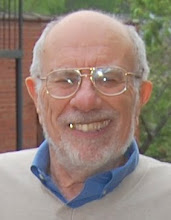
Ludwig Richter [himself a teacher] writes: "Professor Wolff, I would
love it if, in a future post, you would talk about what kind of teaching you do
in the protected space of your classroom. You lecture, of course, but I take it
that you lead discussions and encourage students to offer their interpretations
of texts, and so on. Maybe you could write about that some time?"
As you will have noticed, it takes very little
to get me started, so herewith an extended meditation on my teaching -- not on
teaching, mind, but on my
teaching. I imagine that what I say will
bear very little resemblance to what others might say about their teaching.
Standing
in front of a group of people and talking at them is a rather inadequate
technique for communicating information.
In the twelfth century, when European universities got their start,
books were scarce and very expensive, so probably a professor willing to
lecture was as close as most students came to a library. Indeed, I have read that even in the
nineteenth century, in rural areas of Italy where the peasants were too poor to
buy books and the communities to poor to build schoolhouses and supply them
with blackboards, priests would stand in a field facing a group of little boys
and write in the air. The boys had to
learn to read what the priest "wrote" inverted [which calls to mind
the great old line about Ginger Rogers, that she had to do everything Fred
Astaire did backwards, and in heels -- but I digress.] Today, however, even students from poor
families have far better ways of accessing information. So there is really not much point in using a
classroom to pass along facts that the students could get at faster on their
phones. Fortunately, in Philosophy there
is actually very little information to transmit, and what there is [Descartes'
birth date, how old Kant was when he wrote The
First Critique] doesn't matter very much.
So if I am not telling the students stuff, what
am I doing when I stand in front of them [or sit, as I shall be doing next
semester ]? Well, my answer is rather
odd, and utterly idiosyncratic. What is
more, it took me three decades of teaching before I came to understand it.
Let me start by saying that I am not trying to persuade my students of
anything. Although I frequently teach
politically and ideologically charged texts [as I shall be doing next
semester], it is never my aim to get my students to believe either what it says
in the books I assign or what I say in my lectures. As Kierkegaard says in the inexpressibly
poignant Preface to The Philosophical Fragments, "If
anyone were to be so polite as to assume that I have an opinion, and if he were
to carry his gallantry to the extreme of adopting this opinion because he
believed it to be mine, I should have to be sorry for his politeness, in that
it was bestowed upon so unworthy an object, and for his opinion, if he has no
other opinion than mine."
What I am doing in my teaching, to put it as
simply as I can, is showing beautiful objects to my students in the hope that
they will give to the students the same pleasure that they give me. I conceive this effort on my part as an act
of love, not of propaganda, or inculcation, or persuasion.
The beautiful objects I show to my students are
ideas -- complex ideas, powerful ideas, elegant ideas. Quite often, it costs me enormous effort and
much time to clarify these ideas in my own mind, to extract them from the surroundings
in which I come upon them, and then to find a way to show them forth in their
simplicity and beauty. Only then am I
ready to present them to my students for contemplation, comprehension, and
appreciation. The central argument of
the Transcendental Analytic of the Critique of Pure Reason is such an idea. So is Marx's critique of the ironic structure
of capitalism. The proof of the
Fundamental Theorem of Game Theory is such an idea, as is Hume's account of our
belief in the existence of the continued and independent existence of objects
in space and time.
When I am successful, my students have been offered
what I might call, somewhat altering Spinoza's meaning, an intellectual intuition, which is to say an immediate apprehension
of an intellectual object. I rather
suspect it is what Plato had in mind when he wrote obscurely of a knowledge of
the Form of the Good.
Is my interpretation of A Treatise of Human Nature or Critique
of Pure Reason of Das Kapital
correct? If I am successful, the
interpretation is beautiful, and like all truly beautiful objects,
powerful. Are my interpretations the only correct, or beautiful, or powerful
readings of those texts? Of course
not. Indeed, it is a distinctive mark of
truly great philosophical texts, like truly great novels, that they can sustain
several different and conflicting readings, just as different artists [or even the
same artist at different times] can paint different pictures of the same scene,
model, or subject.
How can one know whether a reading of a text is
powerful or beautiful? The fruitlessness
of the question is manifest. But I can
say this: if the reading is obscure,
convoluted, not immediately graspable by an intelligent and committed reader or
listener [in short, if it is by Hegel] then it is neither powerful nor
beautiful and is probably not worth spending time on.
That, in a nutshell, is what I do when I
teach. I show beautiful ideas to me
students in the [desperate] hope that they will find them beautiful also. Everything else I do is filler.
Have I been successful? It is not for me to say. Is this, Callicles might ask, an honorable
way for an old man to spend his time? I
believe so.