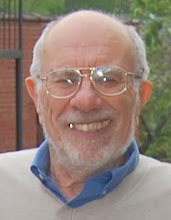
Several of you have, in your comments, expressed an interest in what I have written on the misuse of collective choice theory and rational choice theory and game theory by deterrence theorists, political scientists, and political philosophers. This is a complex subject -- not for the faint of heart. It requires mastering some serious mathematics and all. If there is serious interest out there from people who would be willing to stay with me through what is essentially an entire course on the subject, complete with the technical materials, I would consider starting a totally separate blog on which I would post that material in daily or maybe five times weekly episodes. I would like to know whether anyone is interested enough to stick with it through the whole development. Would you post a comment if you are really interested?
Thanks.
Saturday, April 24, 2010


BELATED READING RECOMMENDATION
Thirty years ago, when Cindy and I moved to Belmont, MA so that she could take up a professorship at MIT, there was a young man living across Garfield Road from us named Ben Friedman. Ben was a cheerful, energetic chap with young children, a member of the Harvard Economics Department. Thirty years later, that young man is Benjamin M. Friedman, a senior Harvard professor and frequent liberal voice on economic matters in The New York Review of Books. I have finally got round to reading Ben's review of two books on the economic crisis in the April 29th issue, and I recommend it to all of you. Those of us a good deal farther on the left than Ben will be tempted to say, "We told you so," and we would be right. But it is good to see some clear and useful words from a former neighbor, so I will content myself with a simple "well done."
MEMOIRS VOLUME TWO EIGHTH INSTALLMENT
Here is the missing installment. Tomorrow I begin Volume Two, Chapter Two of the Memoirs.
The event that separated my first year at Chicago decisively from my second was my marriage to Cindy in June of 1962. We had been seeing each other steadily for almost five years, but the year apart brought things to a head. We both felt that we ought either to get married or end our relationship. We decided on marriage. Cindy's parents were not thrilled, to put it as gently as I can. Her father, James Griffin, was by this time the Vice-President for Public Relations of Sears Roebuck, and the Griffins were living in an elegant apartment in downtown Chicago. They were serious Catholics - her father had been made a Knight of Malta for his fund-raising services to the Church. Our marriage would apparently be a "scandal to the faithful," which pretty much precluded our being married in Shaker Heights, where Cindy had grown up while Griffin was in charge of the Cleveland Group of Sears stores. Nor could we be married in a Catholic Church. At this point, Cindy had decisively left the Church, but she very much wanted her family to be involved in the affair, so we hit upon a geographical and ecclesiastical compromise. We would be married in Appleton Chapel in Harvard Yard by an Episcopalian Minister.
I had taught with Hanna Holborn Gray in Soc Sci 5 at Harvard, as I have already mentioned [see Volume One, Chapter Six]. Hanna, the daughter of the distinguished Yale historian Hajo Holborn, was the fair-haired girl of the Harvard History Department, Myron Gilmore's almost certain successor as the Ren and Ref expert [Renaissance and Reformation, for those not in the know.] But her husband, Charles Gray, a former Junior Fellow teaching at MIT, got a good job at the University of Chicago, and she followed him out. At first, she could only get a position in the College, but eventually, she became Acting President of Yale University, President of the University of Chicago, and is now a member of the Harvard Corporation. When Cindy and I got engaged, Hanna and Charles organized a cocktail party in our honor to celebrate. We were madly rushing around making arrangements and simply forgot about the party. When I came to my senses and realized what we had done, I was so totally mortified that I could not even call to apologize. I simply slunk away and never talked to her again. Even now, forty-eight years later, I cringe when I think about it. Hanna, if by some chance you have found your way to this blog, will you at long last accept my most humble apologies?
When Cindy and I settled upon our engagement, I called my parents to tell them the good news. Appleton Chapel is not a large church, so we agreed that it would have to be a small wedding. Cindy had a brother and an uncle and aunt in addition to her parents, and of course none of her father's Catholic business associates could consider attending, so the bride's party would be pretty small. On my side were my mother and father and sister, but I wanted as well to invite my favorite aunt and uncle, as well as my grandmother, if she could make it at her then advanced age. I told my mother that I wanted to invite only the absolutely inner circle of family. She thought for a long minute and said, "Well, there are thirty-five." "No, no, Ma, " I said, "You don't understand. There isn't room for everybody. I just want the irreducible minimum." "You don't understand," she replied. 'You don't have to live with them after the wedding."
In the end, only my parents and my sister came to the wedding. The remainder of the guests were all our friends from our Harvard days. The Winthrop House Senior Common Room attended, led by David Owen. The Moores were there, along with David Riesman and a host of other Harvard Square types. At the appropriate moment in the ceremony, i intoned the ritual words, "In the name of the Father, and of the Son, and of the Holy Ghost." Since I was a confirmed atheist, I adopted a cultural anthropological rather than a doctrinal attitude toward this element of the ceremony, but I was the first person in my extended family ever to utter those words, and when they crossed my lips, there was a collective inrushing of breath from the groom's side of the aisle.
Cindy and I set up light housekeeping in an apartment at 5550 South Dorchester, two blocks from my old apartment. The wedding presents flowed in from both sides of the marriage. From Cindy's side came a good deal of silver plate and Steuban crystal, courtesy of her father's business associates, along with a little gaudily painted china figurine of The Infant of Prague. From my side came a scroll stating that ten trees had been planted in Israel in our name. We had more than enough good china and crystal, but we were short on money, so we decided to return a collection of expensive but unwanted wedding gifts to the stores in Cleveland from which they had come. We loaded up the VW bug and drove to Ohio. A number of the items had come from the same place, Halle's Department Store in downtown Cleveland. When we got there, Cindy said she would stay in the car while I went up to do the returns. Things went pretty well until I got to the Steuben Room. When I handed in the pair of Steuben sugar and cream servers, explaining lamely that they were a duplicate, the saleslady looked at me askance and asked whether I really wanted to return them. "Oh, yes," I assured her brightly. She opened the little file card holder in which each patron's purchases were carefully recorded on a separate card. She paged through the file until she came to a thick group of cards clipped together. It seemed the gift was from Mr. Halle himself, the owner of the store. I beat a hasty retreat and had a few words with Cindy in the car.
Cindy had completed her coursework for the doctorate in English Literature, and was studying for her oral examinations. Let me take just a moment to explain what this involved. Cindy was going to spend two hours being quizzed by three members of the Harvard English Department on English Literature -- all of it. Everything was fair game, from Beowulf to Finnegan's Wake. Poetry, drama, fiction, non-fiction prose, all of it. Night after night, Cindy plowed her way through everything she had not already mastered, preparing herself for the examination. That ordeal gave her a grounding for her career that no selection of "special fields' could have matched.
Meanwhile, since we needed the money, Cindy got herself a job at Illinois Institute of Technology teaching a required Humanities course to budding engineers. Three times a week she would get in the VW and drive north to 33rd street, where she would face a class of students who really did not want to be there. By the time the second semester had rolled around, she had worked her way to the poetry section. One day, she went into class to discuss a sonnet by Robert Frost. She labored hard to show the students how much thought Frost had put into his poem, even holding up a xeroxed copy of the original hand-written text, with Frost's emendations. The students weren't having any of it. They refused to believe there could be that much in a poem. Finally, in exasperation, she asked them, "How long do you imagine it took Frost to write this poem?" Well, this was a time and motion problem that a group of engineers could get their teeth into, and a lively argument broke out in the class, with the students even ignoring Cindy in their excitement. At one point, a student looked up and asked, "Is this an early poem or a late poem?" Cindy told him it was a late poem. More deliberation. Finally, as engineers will, they came to a group consensus. Since it was a late poem, they said, and he must have been quite practiced at poetry by the time he came to write it, they agreed that it would have taken him a minute a line. Fourteen lines, fourteen minutes. That night, Cindy was in such despair that she seriously considered quitting her job. I protested that we needed the money, and pushed her out the door the next morning to go to class.
Once my manuscript had been accepted by Harvard, there was a great deal of work to be done before it actually became a book. First came a host of small revisions in response to Beck's four pages of comments. This was followed by the copy-edited manuscript, the galleys, and the page proofs. I always find this process rather fun. It requires no intelligence whatsoever, and still gives you the sense that you are doing something productive. And it is always enjoyable to spend time with your own words, a holdover, I suppose, from our infantile fascination with our own feces. But then came the business of preparing an index. This being my first book, I had never done an index before. Those of you reading these words who are entirely creatures of the digital age probably do not appreciate what an excruciating task it was to produce an index for a book. For you, it is just a matter of going to the right drop-down menu and clicking on the appropriate item. In the old days [back when we all walked seven miles to school in our bare feet through the snow -- those old days], things were different. You bought an enormous stack of file cards, sat down with a set of page proofs [you had to know the page on which a word appeared in order to index it, of course], and went through the text, flagging each item you thought ought to be in the index. After a while, a blizzard of cards would pile up on the floor, and you would spend most of your time clawing through it frantically trying to find the card on which you knew you had already written "a prior synthesis.” When I was done, I swore Never again. Whatever it cost, I would pay to have it done. And so I have. That was my first and last engagement with indexing.
Cindy aced her orals. They scarcely touched on most of what she had crammed into her head, of course -- they were only two hours long, after all -- but the preparation for them left her with a command of the entire sweep of English Literature that has stood her in good stead to the present day. Having become what we all in the Academy now refer to as ABD, she decided to write her doctoral dissertation on the relationship between the epistolary novels of the eighteenth century English writer Samuel Richardson and the literature of Puritan self-examination out of which they had emerged.
Friday, April 23, 2010
A PHILOSOPHICAL QUESTION
I was reading a schlock spy novel this morning, in which one of the characters tells a joke to another character. Since Brian Leiter's mention of my blog in his blog has brought a number of philosophers to this site, I thought I would repeat the joke, because it raises an interesting and completely unimportant philosophical question, which is exactly right for a blog, yes?
JOKE: Two lawyers go into a bank together to do some business. While they are there, an armed gunman holds up the bank and says, "Line up and empty your pockets. I am going to take all of your cash." The first lawyer stuffs a handful of cash into the second lawyer's pocket. The second lawyer says, "What are you doing?" The first lawyer replies, "This is everything I owe you."
Philosophical question: Has the first lawyer satisfactorily fulfilled his moral obligation to the second lawyer?"
If any lawyers are reading this, has the first lawyer fulfilled his legal obligation to the second lawyer?
JOKE: Two lawyers go into a bank together to do some business. While they are there, an armed gunman holds up the bank and says, "Line up and empty your pockets. I am going to take all of your cash." The first lawyer stuffs a handful of cash into the second lawyer's pocket. The second lawyer says, "What are you doing?" The first lawyer replies, "This is everything I owe you."
Philosophical question: Has the first lawyer satisfactorily fulfilled his moral obligation to the second lawyer?"
If any lawyers are reading this, has the first lawyer fulfilled his legal obligation to the second lawyer?
ALERT ALERT I HAVE SCREWED UP
I posted the final installment of Chapter One today before posting the next to last installment. Aaaarrrrgggghhhh!!! Tomorrow, I shall post the missing installment, before moving on the Chapter Two. Is there significance in the fact that the missing installment concerns my marriage? I leave that to armchair psychoanalysts. Sorry about that.
MEMOIRS VOLUME TWO NINTH INSTALLMENT
This is perhaps as good a time as any to say something about the effect of my relationship with Cindy on my knowledge of literature and the techniques of its interpretation. I have never been an avid reader of classy fiction. As I have already noted, I began as a boy with an interest in Sherlock Holmes, moved on to science fiction, switched to detective fiction in college, and on occasion read the odd schlock spy novel. While fulfilling my undergraduate Humanities requirement with a single year long survey course, I had in fact read The Brothers Karamazov, and that had prompted me, unbidden, to plow through Crime and Punishment and The Idiot as well. I had read War and Peace as a graduate student, although I needed the encouragement of the Henry Fonda, Audrey Hepburn, Mel Ferrar, Anita Ekberg movie to make it all the way through, and I must admit, with considerable embarrassment, that in my first graduate year, during a rather dark night of the soul, I read The Fountainhead. But literature was not, by any stretch of the imagination, my constant companion.
Nevertheless, when Cindy started working on some author, I routinely plunged in and read a bunch of the books she was dealing with. Partly this was simply out of curiosity, of course, but much more was going on. I found Cindy's mind fascinating -- powerful, intuitive, original. Though I did not know much about literature, I knew a good deal about intelligence, and Cindy was the genuine article. In some ways, Cindy's intellectual relation to her field resembled my relation to mine. Neither of us was a typical academic scholar. Cindy had an uncanny ability to get inside the head of an author on whom she was working, in order to divine the complex of feelings that drove the work. I puzzled over this ability a good deal, because it was so different from the way my mind worked. I was constantly struggling to find the core idea in a text and then to reconstruct it into a rigorous argument. Cindy seemed to be able to let down the psychic barrier between herself and the author and somehow allow the author to live in her mind, so that she could, in effect, know what the author was thinking not by examining texts but rather by merely introspecting. This ability, which I finally came to understand was the cause of a good deal of the trouble in our marriage, was a source of enormous strength in Cindy's work. It is perhaps not so obvious in her first book, on Samuel Richardson, but it is clearly at the heart of the brilliance of her books on Edith Wharton and Emily Dickinson.
During our twenty-three year marriage, I discussed Cindy's reading with her, listened to her textual explications and interpretations, read every word she wrote, commented on it, edited it, and slowly, by what I have on occasion referred to only half-jokingly as pillow talk, acquired a fairly sophisticated understanding of great fiction. Although I learned almost everything I know about literature from Cindy, I was never able to incorporate an author into myself in the way she did. I would not say I was an autodidact, because I did not teach myself. I suppose I might be called an uxor-didact, if such a word could exist. Those twenty-three years contained too much pain and strife to be called happy, but the intellectual bond between us never weakened. Even near the end, when we were struggling unsuccessfully to hold the marriage together, we continued to talk about her work, which by then focused on Emily Dickinson.
Although I have not thus far said much about my own writing, save for the books on Kant and deterrence theory, I was fairly regularly writing about political issues and also the occasional philosophical piece. While still at Harvard, I wrote a piece for the Nation on "Moral Standards in Foreign Policy," and also published an attack on Herman Kahn in The New Republic [back before Marty Peretz got his hands on it] called The Game of War." Osborne produced a splendid cover cartoon for the piece, which led off the February, 1960 issue. Stanley Hoffman, the wry, mordant political scientist who was the first Director of Social Studies at Harvard, put me in touch with s French journal called Les Cahiers de la République, in which I published two articles. I also wrote a number of pieces for the Committees of Correspondence Newsletter. I wrote some reviews for The Bulletin of Atomic Scientists and I contributed pieces to New University Thought and Dissent. I never thought of any of this as a contribution to scholarship, of course, and in my vita, I actually separate it out from my philosophical work. The books on Kant and deterrence pretty much constituted my serious writing in this period, although I did publish, in the Chicago based journal Ethics, the first of what would be many essays on the relationship between formal models and normative theory, under the title "Reflections on Game Theory and the Nature of Value." I even found time to review Laws of Freedom by the excellent and always under-appreciated Kant scholar, Mary Gregor.
As our first year of marriage was nearing an end, Ingrid Stadler wrote to say that she was going on leave from her position at Wellesley, and asked whether I would be interested in spending a year as a visitor replacing her. Cindy and I were not happy to be living in Chicago, and I jumped at the opportunity to move back East. Since Bert Dreyfus was teaching in the Humanities Department at MIT, I thought I might be able to wangle a professorship there so that we could stay in Cambridge. Cindy got a job teaching Freshman Composition at B. U. for the year [always a back-breaking assignment], and we prepared to move East.
At about that time, my Kant book actually appeared. I held the first copy reverentially, smelled the pages, and ran my hand over the slightly nubby cover. Then I opened it to the page of Acknowledgements, and my heart stopped. I had written an effusive encomium to C. I. Lewis, who had been my model of what a philosopher should be, explaining that I had been privileged to attend his lectures on Kant. At least that is what I thought I had written. There on the page, it said "attend his lectures at Kant." I may very well be the only person who ever saw that error -- it was corrected in the next printing. But then, when the architect of a beautiful formal garden casts her eye over the ranks of exquisitely organized plants, she probably only sees the single petunia whose head is drooping.
With this post, I bring to a close the first chapter of Volume Two of my memoirs. Tomorrow, I shall begin Chapter Two.
Thursday, April 22, 2010
GLOBAL WARMING -- A SOMEWHAT DIFFERENT PERSPECTIVE
All of us, I can say with confidence, are aware of the debates about global warming, at least at the level of political dispute. The present state of the debate seems to be this: Most experts agree that human activities, including the burning of fossil fuels and the deforestation of large areas, are having the effect of raising the world's average temperature, with potentially far-reaching consequences for agriculture, the viability of coastal settlements, and so forth. A relatively small minority of experts disagree. Those who accept the judgment of the majority of experts conclude that the nations of the world should take deliberate and sometimes costly efforts to reduce carbon emissions; those who accept the minority judgment disagree. This then has become a signature left-right debate, with those on the left calling for immediate action and those on the right claiming that such action will have a disastrous effect on the profitability of capital. Everyone engaged in the debate seems to agree that the decision to control carbon emissions should depend on one's evaluation of the claim that carbon emissions are causing global warming. I should like to suggest that this is confused way of thinking. I offer these thoughts in the full acknowledgement that I am a complete tyro when it comes to the relevant science. My knowledge is limited to the reading of a few books [including a bizarre novel by Michael Crichton that is a thinly disguised polemic against the defenders of the global warming thesis]
There is no scientific disagreement about the well-established fact that the average temperature of the earth has varied considerably over the past several billion years. At one point, it appears that for several hundred million years the entire earth was covered with ice [the "snowball earth" thesis], and the Great Lakes, Finger Lakes, and other familiar geological formations are evidence of the periodic advance and retreat of glacial fields. There has even been a period of temperature fluctuation in the relatively recent historical past. Starting the the late 13th century, glaciers advanced in Northern Europe much farther south than their present location, with the result that the customary warm summers of Europe became unreliable. The last major glacial period, or ice age, ended not too long before the beginning of recorded history, perhaps twelve thousand years ago or a bit more.
During most of human history, changes in the earth's temperature, though they had an effect on the human population, by altering the location and extent of areas that were habitable, did not pose a major threat to humans because there were so few of them on the face of the planet. But in the past century or two, the human population has exploded, with two very important consequences. First, feeding the world's population now requires the industrialization of agriculture. Both the gross output and the year by year reliability of agricultural output is now essential to a population that is primarily urban and completely cut off from arable land or the activity of food production. Second, people have settled along vast stretches of low-lying coastal areas, not only in places like Bangladesh but also in North and South America and Europe. It would take only a relatively minor fluctuation in the earth's average temperature to produce horrendous disruptions both to the food supply and to those coastal settlements. Therefore, it is very much in the interest of the entire world that the temperature of the earth remain quite stable, neither rising nor falling more than a degree or two [which, contrary to one's intuition, is all by itself enough to produce important disruptions.]
Unfortunately, the evidence of the last several billion years makes it clear that the average temperature of the earth does not remain stable over long periods of time. Left to its own devices, the earth grows cooler and warmer all by itself.
So the consensus about the Global Warming controversy, it seems to me, is wrong. The crucial question is not whether carbon emissions are the cause of what appears to be a recent trend of global warming. The only relevant question is whether human activity can, in any way, be a contributing factor in the short-term determination of global temperature. I say "short term," because even if the earth is going to go through another major glaciation some time in the next ten or fifteen thousand years, which is to say a major global cooling, it makes an enormous difference to human beings how the earth's temperature changes in the next several centuries. A two or three century long period of global warming would be perfectly compatible with a thirty thousand year cycle of glaciation. From the perspective of geological time, such a minor variation would be insignificant, even though it might be catastrophic for us and the next fifteen or twenty generations to follow us.
So, it would be very useful to alter the terms of the current debate. Can human activity have a measurable effect on the earth's average temperature, regardless of the underlying causes of long-term temperature cycles? Can we figure out what that effect is? Are there things the world's population can do to tweak the temperature fluctuations so as to dampen potentially catastrophic short-term shifts?
These are the questions we ought to be asking. I am not competent to answer them, though I am impressed by the evidence that the answer to all three of these questions is Yes.
There is no scientific disagreement about the well-established fact that the average temperature of the earth has varied considerably over the past several billion years. At one point, it appears that for several hundred million years the entire earth was covered with ice [the "snowball earth" thesis], and the Great Lakes, Finger Lakes, and other familiar geological formations are evidence of the periodic advance and retreat of glacial fields. There has even been a period of temperature fluctuation in the relatively recent historical past. Starting the the late 13th century, glaciers advanced in Northern Europe much farther south than their present location, with the result that the customary warm summers of Europe became unreliable. The last major glacial period, or ice age, ended not too long before the beginning of recorded history, perhaps twelve thousand years ago or a bit more.
During most of human history, changes in the earth's temperature, though they had an effect on the human population, by altering the location and extent of areas that were habitable, did not pose a major threat to humans because there were so few of them on the face of the planet. But in the past century or two, the human population has exploded, with two very important consequences. First, feeding the world's population now requires the industrialization of agriculture. Both the gross output and the year by year reliability of agricultural output is now essential to a population that is primarily urban and completely cut off from arable land or the activity of food production. Second, people have settled along vast stretches of low-lying coastal areas, not only in places like Bangladesh but also in North and South America and Europe. It would take only a relatively minor fluctuation in the earth's average temperature to produce horrendous disruptions both to the food supply and to those coastal settlements. Therefore, it is very much in the interest of the entire world that the temperature of the earth remain quite stable, neither rising nor falling more than a degree or two [which, contrary to one's intuition, is all by itself enough to produce important disruptions.]
Unfortunately, the evidence of the last several billion years makes it clear that the average temperature of the earth does not remain stable over long periods of time. Left to its own devices, the earth grows cooler and warmer all by itself.
So the consensus about the Global Warming controversy, it seems to me, is wrong. The crucial question is not whether carbon emissions are the cause of what appears to be a recent trend of global warming. The only relevant question is whether human activity can, in any way, be a contributing factor in the short-term determination of global temperature. I say "short term," because even if the earth is going to go through another major glaciation some time in the next ten or fifteen thousand years, which is to say a major global cooling, it makes an enormous difference to human beings how the earth's temperature changes in the next several centuries. A two or three century long period of global warming would be perfectly compatible with a thirty thousand year cycle of glaciation. From the perspective of geological time, such a minor variation would be insignificant, even though it might be catastrophic for us and the next fifteen or twenty generations to follow us.
So, it would be very useful to alter the terms of the current debate. Can human activity have a measurable effect on the earth's average temperature, regardless of the underlying causes of long-term temperature cycles? Can we figure out what that effect is? Are there things the world's population can do to tweak the temperature fluctuations so as to dampen potentially catastrophic short-term shifts?
These are the questions we ought to be asking. I am not competent to answer them, though I am impressed by the evidence that the answer to all three of these questions is Yes.
Subscribe to:
Posts (Atom)