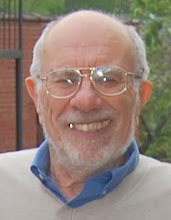
Susie and I own a small apartment in the heart of old Paris, which we rent out when we are not there, using as our sole medium of advertising the classifieds at the back of the New York Review of Books [look for "Paris 5th -- Blue State Special"]. Yesterday, an old, old friend from graduate student days, who had stumbled on the ad, reconnected with me via email. Ingrid Stadler and I were graduate students in philosophy together at Harvard in the middle fifties, both of us interested in Immanuel Kant. She went on to spend her entire career at Wellesley College, from which she is now retired. Indeed, in 1983-64, when she was on leave, I replaced her as a visiting professor.
Ingrid is a very slight woman, barely over five feet tall, always rather elegantly dressed. She was married then [and still is, I believe], to Steve Stadler, who was in business. We were all as poor as church mice, living in modest digs and, on rare occasions, splurging on a group outing to the original Joyce Chen restaurant, where we ate as fast as we could to get our share of the food [that is how I perfected my chop stick skills.] Steve and Ingrid, by contrast, lived in a real apartment on the Charles River, drove matching sports cars, and had a life. Save for the very pregnant Henny Wenkart and the ill-fated Joe Swanson, she was, I think, the only married grad student. If I remember rightly, one year Steve hired a barge and some musicians and for Ingrid's birthday floated her down the Charles to the strains of Handel's Water Music. How cool is that!
When I had completed the manuscript of my first book, Kant's Theory of Mental Activity, in the summer of 1961,I asked Ingrid to read it, which she did, making many useful suggestions. I did not realize it then, but that would be the last time I would ask anyone to read a book I had written before sending it off to the publisher!
Why, you might wonder, so deviant a bit of scholarly behavior. The reason, I now realize, is that I do not view my writing as scholarship. I think of it as story telling -- the story of an idea -- or as the painting of a picture. One cannot imagine the young Matisse sending a canvas to Cezanne for comments and criticisms -- "I think a little more chrome yellow in the upper right hand corner, Henri" -- or appending to a still life the notation, "For the shape of the pear, I am indebted to Renoir." Perhaps this is why my books have so few footnotes, and often no bibliography, a fact that irritates my scholarly friends, who, when they have completed a manuscript, spend endless hours nailing down the correct references to the books and articles they have cited.
Ingrid says that when she has solved the problem of how to post a comment, she will do so. I very much hope that she will.
Showing posts with label Harvard. Show all posts
Showing posts with label Harvard. Show all posts
Saturday, December 5, 2009


Tuesday, October 13, 2009
GIANTS IN THE EARTH
There were giants in the earth in those days [Genesis 6:4]
I had a dream last night in which I found myself talking to a group of Harvard students [prompted, perhaps, by the telephone chat with my son, Tobias, who is teaching this semester at Harvard Law School.] When I woke up, the dream was still vivid in my mind, and it prompted me to think back to my time as an Instructor at Harvard, in the late '50s and very early '6os [of the twentieth, not the nineteenth, century!] I ended up looking back at my course files from that period, including the file on the tutorial that I taught jointly with Barrington Moore, Jr. in the first year of a new interdisciplinary undergraduate major, Social Studies, now about to celebrate its fiftieth year in operation. I was the first Head Tutor of Social Studies, appointed by McGeorge Bundy, who the next year left Harvard to become John Kennedy's National Security Advisor. Social Studies was intended to give a select group of students an opportunity to study the social sciences in an integrated fashion, without regard for the disciplinary boundaries that at that time so markedly divided the several branches of the sozialwissenschaften from one another. The program has been a considerable success, and is now, I believe the third or fourth largest major field at Harvard.
Moore and I took charge of six sophomores, for whom, it should be noted, this tutorial was an ungraded add-on to their normal course load. Oncde a week, we met in my rooms in Winthrop House, where I was a resident tutor, for two hours. It was a bit like tag-team wrestling. Moore would start in ion them for a while, quizzing them about the reading for that session. When he flagged, he would tap me and I would jump in, picking up the pace. After two hours, the students were wrung through.
To give you some idea of how intense it was, let me simply reproduce, from my notes, the year's reading list [there were, that first year, three tutorial groups of six students each, taught by pairs of faculty so selected that each pair represented two different disciplines.]
The first reading was Adam Smith's WEALTH OF NATIONS -- all 900 pages of it! This was followed either by Schumpeter's THEORY OF ECONOMIC DEVELOPMENT or John Stuart Mill's two-volume POLITICAL ECONOMY [the choice Moore and I made.] Next up was a volume of Marx's writings edited by Lewis Feuer, and then Alexis de Tocqueville's THE OLD REGIME AND THE FRENCH REVOLUTION [a relatively light bit of reading.] Students now then did an abrupt turn, and tackled the two volume PRIMITIVE CULTURE by Sir Edward Tylor [some groups substituted Maine's ANCIENT LAW.] We were also supposed to go through Franz Boas' THE MIND OF PRIMITIVE MAN, but Moore and I took a pass on that one -- I think we had lingered too long on Marx. This was followed by Nietzsche's GENEOLOGY OF MORALS and Freud's CIVILIZATION AND ITS DISCONTENTS. The Nietzsche was drawn from a large collection edited by Walter Kaufman, and students were advised, parenthetically, that they should read other selections from the volume. Whether any of them did, I do not recall. Well, after that light Freud break, it was back to Emile Durkheim's SUICIDE and 350 pages of Marx Weber [the merest scratching of the surface, as those who are familiar with Weber weill recognize.] The year-long tutorial wrapped up with R. G. Collingwood's THE IDEA OF HISTORY and Alfred North Whitehead's MODES OF THOUGHT [I was opposed to that choice, never having found Whitehead's philosophy, as opposed to his mathematical logic, of much interest, but as the only non-tenured member of the Social Studies Committee I was overruled, even though I was the only philosopher in the group.]
Well, as the Emperor Joseph says in AMADEUS, there it is.
In those days, tuition at Harvard was a couple of thousand dollars a year. I think the students got their money's worth.
I had a dream last night in which I found myself talking to a group of Harvard students [prompted, perhaps, by the telephone chat with my son, Tobias, who is teaching this semester at Harvard Law School.] When I woke up, the dream was still vivid in my mind, and it prompted me to think back to my time as an Instructor at Harvard, in the late '50s and very early '6os [of the twentieth, not the nineteenth, century!] I ended up looking back at my course files from that period, including the file on the tutorial that I taught jointly with Barrington Moore, Jr. in the first year of a new interdisciplinary undergraduate major, Social Studies, now about to celebrate its fiftieth year in operation. I was the first Head Tutor of Social Studies, appointed by McGeorge Bundy, who the next year left Harvard to become John Kennedy's National Security Advisor. Social Studies was intended to give a select group of students an opportunity to study the social sciences in an integrated fashion, without regard for the disciplinary boundaries that at that time so markedly divided the several branches of the sozialwissenschaften from one another. The program has been a considerable success, and is now, I believe the third or fourth largest major field at Harvard.
Moore and I took charge of six sophomores, for whom, it should be noted, this tutorial was an ungraded add-on to their normal course load. Oncde a week, we met in my rooms in Winthrop House, where I was a resident tutor, for two hours. It was a bit like tag-team wrestling. Moore would start in ion them for a while, quizzing them about the reading for that session. When he flagged, he would tap me and I would jump in, picking up the pace. After two hours, the students were wrung through.
To give you some idea of how intense it was, let me simply reproduce, from my notes, the year's reading list [there were, that first year, three tutorial groups of six students each, taught by pairs of faculty so selected that each pair represented two different disciplines.]
The first reading was Adam Smith's WEALTH OF NATIONS -- all 900 pages of it! This was followed either by Schumpeter's THEORY OF ECONOMIC DEVELOPMENT or John Stuart Mill's two-volume POLITICAL ECONOMY [the choice Moore and I made.] Next up was a volume of Marx's writings edited by Lewis Feuer, and then Alexis de Tocqueville's THE OLD REGIME AND THE FRENCH REVOLUTION [a relatively light bit of reading.] Students now then did an abrupt turn, and tackled the two volume PRIMITIVE CULTURE by Sir Edward Tylor [some groups substituted Maine's ANCIENT LAW.] We were also supposed to go through Franz Boas' THE MIND OF PRIMITIVE MAN, but Moore and I took a pass on that one -- I think we had lingered too long on Marx. This was followed by Nietzsche's GENEOLOGY OF MORALS and Freud's CIVILIZATION AND ITS DISCONTENTS. The Nietzsche was drawn from a large collection edited by Walter Kaufman, and students were advised, parenthetically, that they should read other selections from the volume. Whether any of them did, I do not recall. Well, after that light Freud break, it was back to Emile Durkheim's SUICIDE and 350 pages of Marx Weber [the merest scratching of the surface, as those who are familiar with Weber weill recognize.] The year-long tutorial wrapped up with R. G. Collingwood's THE IDEA OF HISTORY and Alfred North Whitehead's MODES OF THOUGHT [I was opposed to that choice, never having found Whitehead's philosophy, as opposed to his mathematical logic, of much interest, but as the only non-tenured member of the Social Studies Committee I was overruled, even though I was the only philosopher in the group.]
Well, as the Emperor Joseph says in AMADEUS, there it is.
In those days, tuition at Harvard was a couple of thousand dollars a year. I think the students got their money's worth.
Wednesday, August 26, 2009
TEDDY KENNEDY, HARVARD '54
One after another my Harvard classmates pass from the scene. First John Updike, now Teddy Kennedy. I did not know either of them, of course. I was in Adams House, and all the Kennedy boys were in Winthrop. Besides, I was perhaps the least sociable member of the class of '54, and I ended up knowing very few of my more than one thousand classmates. I did visit Kennedy's office in the old Senate Office Building once, but he wasn't in.
Much is being said this morning by the television commentators of Kennedy's ability to forge friendships cross the aisle, and the role that played in his unparallelled legislative success. There is no doubt much truth to that observation, but I would like to comment on another of Kennedy's characteristics that was, in my judgment, equally important. Kennedy was preternaturally patient in his pursuit of the enactment of the liberal legislation for which he is rightly famous. He was capable of working unflaggingly for decades, suffering defeat after defeat as he tried to build the legislative coalitions that would turn child care or worker protection or health care reform into law. He, more than anyone else in the Congress, will deserve the credit when the health care reform bill now being crafted so laboriously and inelegantly finally passes in a month or two.
One of my readers objected to the fact that I mentioned Stalin in a previous comment about the need for such patience and commitment. I thought I made it clear that I was praising the trait, not the man. But henceforward I will happily cite Teddy when the need arises.
All of us on the left must learn from Kennedy's patience. Those of us, especially, whose professional work consists in having ideas tend to be hopelessly impatient. We get an idea, express it, and think that is the end of it. But as Kierkegaard so wisely observes, whereas novelty is the essence of the aesthetic, repetition is the essence of the ethical [see EITHER/OR].
Much is being said this morning by the television commentators of Kennedy's ability to forge friendships cross the aisle, and the role that played in his unparallelled legislative success. There is no doubt much truth to that observation, but I would like to comment on another of Kennedy's characteristics that was, in my judgment, equally important. Kennedy was preternaturally patient in his pursuit of the enactment of the liberal legislation for which he is rightly famous. He was capable of working unflaggingly for decades, suffering defeat after defeat as he tried to build the legislative coalitions that would turn child care or worker protection or health care reform into law. He, more than anyone else in the Congress, will deserve the credit when the health care reform bill now being crafted so laboriously and inelegantly finally passes in a month or two.
One of my readers objected to the fact that I mentioned Stalin in a previous comment about the need for such patience and commitment. I thought I made it clear that I was praising the trait, not the man. But henceforward I will happily cite Teddy when the need arises.
All of us on the left must learn from Kennedy's patience. Those of us, especially, whose professional work consists in having ideas tend to be hopelessly impatient. We get an idea, express it, and think that is the end of it. But as Kierkegaard so wisely observes, whereas novelty is the essence of the aesthetic, repetition is the essence of the ethical [see EITHER/OR].
Wednesday, August 19, 2009
SOUTH AFRICAN HIGHER EDUCATION PART IV
I suppose you could say that it all started because my first wife was phobic about flying. Cynthia would not get on a plane, so we never went anywhere much. When our twenty-three year marriage ended, in 1985, I was pretty well ready to go anywhere in the world I was invited, so long as I had to fly to get there. The next year, during one of my very rare sabbatical leaves, an old friend, Debra Nails, came through Boston. Debra had been the Aide to Bob Cohen and Marx Wartofsky in their long-running Center for the History and Philosophy of Science, at Boston University, and she was now living in Johannesburg, teaching philosophy at Wits while her husband, Berendt Kock, taught physics. Debra asked me whether I would like to come to South Africa to teach Marx to the second year philosophy students. No one, it seemed, had ever taught Marx at Wits. I jumped at the chance, and on May 28th, at 6:55 p.m., I took off on Pan Am for Africa.
After a brief stopover in Kenya to see the wild animals at Amboseli and Treetops, I flew into Jan Smuts Airport [as it was then called] for a five week stay. [Travel tip: When going on safari, make sure it is the dry season, so that the animals will gather at the waterholes for easy viewing. I got to Amboseli, in the shadow of Mt. Kilimanjaro, after torrential rains, and the animals were scattered all over the enormous plain. On that occasion, I saw very little, but on later trips to Kreuger National Park and in Botswana, I had fabulous adventures. More of that some other time.]
I instantly fell in love with South Africa. During my five weeks, I traveled around the country -- to Durban, on the Indian Ocean, to the Homelands of Gazenkulu, Lebowa, and Bophutatswana, to the township of Soweto, and to the Afrikaaner capital of Pretoria. The country was the most politically alive place I had ever been, and I felt more at home with my new friends and comrades there than with my colleagues in the Philosophy Department at the University of Massachusetts. There are more stories to tell of those early days, but that will have to wait for a future post, for this is the story of the founding of USSAS.
Back in Boston, where I had been living since Cynthia had been appointed to a professorship in Literature at MIT, I fell into the habit of dining one evening a week with Richard Sens, a psychiatrist who was also going through the break-up of a lengthy marriage. For the most part, we commiserated with one another about the painful process, but one evening, Dick brought along a woman who was, he said, a former student of mine. Sure enough, it was Jean Alonzo, who as Freshman Jean Anderson had been a student in one of my discussion sections of Philosophy 1 in 1956. Jean was now a union organizer at Raytheon, and a member of an anti-apartheid organization called Harvard/Radcliffe Alumni/ae Against Apartheid, or HRAAA [pronounced Hurrah]. The goal of HRAAA was to pressure Harvard to divest itself of its investments in companies doing business with South Africa, and its principal tactic was to run write-in candidates for the Harvard Board of Overseers, a body of alums who play a quasi-admnistrative role at Harvard. However, Harvard's 350th anniversary was coming up [Harvard was founded as Harvard College in 1636], and HRAAA was planning a sit-in at a very toney formal dinner for big donors, with Prince Charles, no less, in attendance, to be held at Memorial Hall. Jean asked whether I would like to come along.
I asked whether there was any chance we would be arrested, and when she said yes, I agreed to join them. I had always been rather embarrassed by my failure to get arrested during the Viet Nam War era, and I thought it would make me look better in my sons' eyes if I did get arrested this time out. Off we went on the appointed day, to seat ourselves, arms locked, in front of the door to the Memorial Hall dinner, chanting, as I recall, "If you want to digest, you've got to divest." [I don't actually much like demonstrations, and as many of the guests were my classmates, I felt, I must confess, like a bit of an ass. But I chanted along with the youngsters.] The sit-in was such a total surprise to Harvard that President Bok, who was hosting the dinner, neglected to call the police.
It ended ok, however, Some time later, we held another protest at Fogg Art Museum. This time, Harvard was prepared, and a bunch of us were hauled off in paddy wagons to the Central Square Police Station, where we were booked on charges of trespass or disorderly conduct, and released on our own recognizance. I have always thought that the police, who were not too fond of Harvard, for reasons of class privilege, went easy on us.
After a quite unsatisfactory trial, during which the judge, whose son was a student at Harvard, refused to allow us to offer a "necessity defense," we were found guilt, and sentenced to some community service or a fine of $72.50 a piece. We undertook to appeal, but the tape recording of the trial was so bad that the court stenographer could not produce a usable transcript, and the whole matter died. There was one rather light moment. As we were defending ourselves ["pro se" as the law has it], we were called on during the sentencing phase to propose a suitable punishment for ourselves. Remembering Socrates' great speech at his trial, memorialized in Plato's dialogue, THE APOLOGY, I said to the judge that inasmuch as I had been serving the people of the Commonwealth for many years as a Professor of Philosophy, I thought an appropriate punishment would be for the state to give me a pension. Her grasp of classical philosophy was obviously inferior to her mastery of the law, and she hit me with the $72.50 fine.
In the next two years, I remained active in HRAAA, and we did actually elect several people to the Board of Overseers, including Gay Seidman, daughter of a famous anti-apartheid activist in South Africa, and Peter Wood, a distinguished historian of South Carolinian slavery. In 1988, when HRAAA fell deeply into debt, and the paid Executive Secretary, Dorothee Benz, left to pursue her education, I volunteered to serve as unpaid Executive Director, in an effort to salvage the organization. In the next two years, I raised enough money to put us in the black, and succeeded in getting Archbishop Desmond Tutu elected to the Board. Harvard did not divest, of course. Instead, it changed the rules for electing overseers so that nothing like that would happen again. By the way, the year that I resigned from the Executive Directorship, HRAAA recruited a young Black Harvard Law Student named Barack Obama to run on the weite-in ticket, but I was gone by then, and never met him.
In the Spring of 1990, shortly after Nelson Mandeela was released, I had my one and only meeting with Tutu, who had come to Cambridge for a Board meeting. He thanked me for my efforts, and spoke very movingly about the need for re-investment in South Africa, now that libration was at hand. I realized that the HRAAA effort was now moot, and that I needed to find some other way to work with my South African comrades. At that moment, quite by chance, the Chair of the Philosophy Department at Durban-Westville, Mala Singh, wrote to me with an urgent appeal. Her graduate students had no money to pursue their studies. Was there anything I could do to help? Very quickly, I sent an appeal to some hundreds of philosophers at American colleges and univerities, and managed to raise enough money to enable Mala's students to continue their studies. It occurred to me that this might be the shape of my new effort. I had learned how to raise money by mail, using my computer. Perhaps I could start a charitable organization to offer scholarship aid to poor Black students going to historically Black universities in South Africa. The idea would be to support them there, not bring them to the United States [which would have been prohibitively expensive.] If I worked out of my home and paid myself nothing, I could send virtually everything I raised to the students.
It was clear to me that I needed someone in South Africa to select the students and look after them, someone who would also do this pro bono. On my next trip, I decided to travel around the country, looking for an academic who would be willing to take on this essential, but rather burdensome, task.
Tomorrow: USSAS is Born
After a brief stopover in Kenya to see the wild animals at Amboseli and Treetops, I flew into Jan Smuts Airport [as it was then called] for a five week stay. [Travel tip: When going on safari, make sure it is the dry season, so that the animals will gather at the waterholes for easy viewing. I got to Amboseli, in the shadow of Mt. Kilimanjaro, after torrential rains, and the animals were scattered all over the enormous plain. On that occasion, I saw very little, but on later trips to Kreuger National Park and in Botswana, I had fabulous adventures. More of that some other time.]
I instantly fell in love with South Africa. During my five weeks, I traveled around the country -- to Durban, on the Indian Ocean, to the Homelands of Gazenkulu, Lebowa, and Bophutatswana, to the township of Soweto, and to the Afrikaaner capital of Pretoria. The country was the most politically alive place I had ever been, and I felt more at home with my new friends and comrades there than with my colleagues in the Philosophy Department at the University of Massachusetts. There are more stories to tell of those early days, but that will have to wait for a future post, for this is the story of the founding of USSAS.
Back in Boston, where I had been living since Cynthia had been appointed to a professorship in Literature at MIT, I fell into the habit of dining one evening a week with Richard Sens, a psychiatrist who was also going through the break-up of a lengthy marriage. For the most part, we commiserated with one another about the painful process, but one evening, Dick brought along a woman who was, he said, a former student of mine. Sure enough, it was Jean Alonzo, who as Freshman Jean Anderson had been a student in one of my discussion sections of Philosophy 1 in 1956. Jean was now a union organizer at Raytheon, and a member of an anti-apartheid organization called Harvard/Radcliffe Alumni/ae Against Apartheid, or HRAAA [pronounced Hurrah]. The goal of HRAAA was to pressure Harvard to divest itself of its investments in companies doing business with South Africa, and its principal tactic was to run write-in candidates for the Harvard Board of Overseers, a body of alums who play a quasi-admnistrative role at Harvard. However, Harvard's 350th anniversary was coming up [Harvard was founded as Harvard College in 1636], and HRAAA was planning a sit-in at a very toney formal dinner for big donors, with Prince Charles, no less, in attendance, to be held at Memorial Hall. Jean asked whether I would like to come along.
I asked whether there was any chance we would be arrested, and when she said yes, I agreed to join them. I had always been rather embarrassed by my failure to get arrested during the Viet Nam War era, and I thought it would make me look better in my sons' eyes if I did get arrested this time out. Off we went on the appointed day, to seat ourselves, arms locked, in front of the door to the Memorial Hall dinner, chanting, as I recall, "If you want to digest, you've got to divest." [I don't actually much like demonstrations, and as many of the guests were my classmates, I felt, I must confess, like a bit of an ass. But I chanted along with the youngsters.] The sit-in was such a total surprise to Harvard that President Bok, who was hosting the dinner, neglected to call the police.
It ended ok, however, Some time later, we held another protest at Fogg Art Museum. This time, Harvard was prepared, and a bunch of us were hauled off in paddy wagons to the Central Square Police Station, where we were booked on charges of trespass or disorderly conduct, and released on our own recognizance. I have always thought that the police, who were not too fond of Harvard, for reasons of class privilege, went easy on us.
After a quite unsatisfactory trial, during which the judge, whose son was a student at Harvard, refused to allow us to offer a "necessity defense," we were found guilt, and sentenced to some community service or a fine of $72.50 a piece. We undertook to appeal, but the tape recording of the trial was so bad that the court stenographer could not produce a usable transcript, and the whole matter died. There was one rather light moment. As we were defending ourselves ["pro se" as the law has it], we were called on during the sentencing phase to propose a suitable punishment for ourselves. Remembering Socrates' great speech at his trial, memorialized in Plato's dialogue, THE APOLOGY, I said to the judge that inasmuch as I had been serving the people of the Commonwealth for many years as a Professor of Philosophy, I thought an appropriate punishment would be for the state to give me a pension. Her grasp of classical philosophy was obviously inferior to her mastery of the law, and she hit me with the $72.50 fine.
In the next two years, I remained active in HRAAA, and we did actually elect several people to the Board of Overseers, including Gay Seidman, daughter of a famous anti-apartheid activist in South Africa, and Peter Wood, a distinguished historian of South Carolinian slavery. In 1988, when HRAAA fell deeply into debt, and the paid Executive Secretary, Dorothee Benz, left to pursue her education, I volunteered to serve as unpaid Executive Director, in an effort to salvage the organization. In the next two years, I raised enough money to put us in the black, and succeeded in getting Archbishop Desmond Tutu elected to the Board. Harvard did not divest, of course. Instead, it changed the rules for electing overseers so that nothing like that would happen again. By the way, the year that I resigned from the Executive Directorship, HRAAA recruited a young Black Harvard Law Student named Barack Obama to run on the weite-in ticket, but I was gone by then, and never met him.
In the Spring of 1990, shortly after Nelson Mandeela was released, I had my one and only meeting with Tutu, who had come to Cambridge for a Board meeting. He thanked me for my efforts, and spoke very movingly about the need for re-investment in South Africa, now that libration was at hand. I realized that the HRAAA effort was now moot, and that I needed to find some other way to work with my South African comrades. At that moment, quite by chance, the Chair of the Philosophy Department at Durban-Westville, Mala Singh, wrote to me with an urgent appeal. Her graduate students had no money to pursue their studies. Was there anything I could do to help? Very quickly, I sent an appeal to some hundreds of philosophers at American colleges and univerities, and managed to raise enough money to enable Mala's students to continue their studies. It occurred to me that this might be the shape of my new effort. I had learned how to raise money by mail, using my computer. Perhaps I could start a charitable organization to offer scholarship aid to poor Black students going to historically Black universities in South Africa. The idea would be to support them there, not bring them to the United States [which would have been prohibitively expensive.] If I worked out of my home and paid myself nothing, I could send virtually everything I raised to the students.
It was clear to me that I needed someone in South Africa to select the students and look after them, someone who would also do this pro bono. On my next trip, I decided to travel around the country, looking for an academic who would be willing to take on this essential, but rather burdensome, task.
Tomorrow: USSAS is Born
Thursday, July 23, 2009
HENRY LOUIS GATES -- THE SEQUEL
Well, everyone else has had a say about the arrest of Skip Gates, including the president [who handled it with considerable grace and some wit], so why shouldn't I? There is one aspect of the story -- in many ways the most important -- that has gone more or less unnoticed.
Let us forget about race for a moment, and just talk about class. Everyone who knows Harvard Square -- which in my youth really meant one small square, but now means much of Cambridge -- knows that there is a clear visual and body language distinction between town and gown, which is to say between people who are associated in some way with Harvard and people who live in Cambridge or work there or are passing through but are not students or professors or administrators or researchers. The Harvard folk dress differently, do their hair differently, walk differently, carry different objects [book bags, for example], and in general are immediately identifiable. Now, this is profiling, of course, and it is accurate profiling. I would bet that if you tested me or anyone else who knows The Square, we could distinguish Harvard types from non-Harvard types eighty or ninety percent of the time or better.
For a while now -- three hundred years or so -- the Cambridge police have treated the gown folk differently from the town folk. The gown folk are cut a good deal of slack, and the police force tends to abide by the maxim that What happens in The Yard stays in the Yard. [Notice, a propos, that as soon as the arresting officer found out that Gates was a Harvard professor, he called the Harvard police, even though the entire event took place off Harvard property.]
Think about Henry Louis Gates, abstracting, for a moment, from his Blackness. Anyone who saw Gates in the vicinity of Harvard would immediately recognize him as gown, regardless of whether they actually knew who he was. [By the way, Gates is not simply "a Harvard professor." He is what Harvard calls a University Professor, a title bestowed on only six or eight members of the entire faculty, and carrying with it the very highest academic status. But never mind that.] What is more, the incident took place on a very toney Harvard street, where the homeowners are all rich and upper middle class. A policeman seeing an obvious White gown type trying to enter a house on that street would NEVER, and I mean NEVER, imagine that he was "breaking and entering." Of course, he actually might be breaking and entering [upper middle class people do illegal things], but no policeman would think that he was. NOR WOULD A "NEIGHBOR" WHO LIVES ON THE SAME STREET THINK SO, EVEN IF SHE DID NOT KNOW HER NEIGHBORS BY SIGHT.
THE ONLY REASON THIS HAPPENED IS THAT GATES IS BLACK, A FACT THAT TOTALLY BLOTTED OUT EVERY OTHER CONSIDERATION IN THE MIND BOTH OF THE NEIGHBOR AND OF THE POLICEMAN.
Sigh. You really have to know the history and culture of Harvard Square to feel, in your gut, just how impossible this entire incident would have been, had Gates been White.
Let us forget about race for a moment, and just talk about class. Everyone who knows Harvard Square -- which in my youth really meant one small square, but now means much of Cambridge -- knows that there is a clear visual and body language distinction between town and gown, which is to say between people who are associated in some way with Harvard and people who live in Cambridge or work there or are passing through but are not students or professors or administrators or researchers. The Harvard folk dress differently, do their hair differently, walk differently, carry different objects [book bags, for example], and in general are immediately identifiable. Now, this is profiling, of course, and it is accurate profiling. I would bet that if you tested me or anyone else who knows The Square, we could distinguish Harvard types from non-Harvard types eighty or ninety percent of the time or better.
For a while now -- three hundred years or so -- the Cambridge police have treated the gown folk differently from the town folk. The gown folk are cut a good deal of slack, and the police force tends to abide by the maxim that What happens in The Yard stays in the Yard. [Notice, a propos, that as soon as the arresting officer found out that Gates was a Harvard professor, he called the Harvard police, even though the entire event took place off Harvard property.]
Think about Henry Louis Gates, abstracting, for a moment, from his Blackness. Anyone who saw Gates in the vicinity of Harvard would immediately recognize him as gown, regardless of whether they actually knew who he was. [By the way, Gates is not simply "a Harvard professor." He is what Harvard calls a University Professor, a title bestowed on only six or eight members of the entire faculty, and carrying with it the very highest academic status. But never mind that.] What is more, the incident took place on a very toney Harvard street, where the homeowners are all rich and upper middle class. A policeman seeing an obvious White gown type trying to enter a house on that street would NEVER, and I mean NEVER, imagine that he was "breaking and entering." Of course, he actually might be breaking and entering [upper middle class people do illegal things], but no policeman would think that he was. NOR WOULD A "NEIGHBOR" WHO LIVES ON THE SAME STREET THINK SO, EVEN IF SHE DID NOT KNOW HER NEIGHBORS BY SIGHT.
THE ONLY REASON THIS HAPPENED IS THAT GATES IS BLACK, A FACT THAT TOTALLY BLOTTED OUT EVERY OTHER CONSIDERATION IN THE MIND BOTH OF THE NEIGHBOR AND OF THE POLICEMAN.
Sigh. You really have to know the history and culture of Harvard Square to feel, in your gut, just how impossible this entire incident would have been, had Gates been White.
Monday, April 30, 2007
The Value of a Harvard Ph D
This June will mark the fiftieth aniversary of the day on which I was awarded a doctorate in Philosophy by Harvard University. Over the intervening years, many people have indicated that they were impressed by this fact. It seems, therefore, an appropriate time to say a few words about the real value of a Harvard Ph D. A brief story from the first volume of my unpublished memoirs will set the record straight.
After earning my degree, and serving six months in the army as part of my six year commitment to the Massachusetts National Guard, I returned to Cambridge and spent 1958-61 as a Instructor in Philosphy and General Education. I was quite young, and not yet ready even to call my colleagues by their first names, inasmuch as they had, only a year earlier, been my professors.
At one of the infrequent department meetings [in my first year, if I recall correctly], Raphael Demos laid a problem before the assembled faculty. Demos at that time was near retirement, quite the oldest member of the department. It seems that he had heard from a former student who had left the department twenty-five years earlier without a doctorate. This man had made a career and a life for himself teaching philosophy at a small Canadian college. Now his college had decided to become a university, and it was retroactively requiring all of its faculty to have Ph Ds. The chap had sent Demos some material he had been writing on Kant and wanted to know whether he could submit it as a dissertation.
Demos said he had read it, and that it was simply awful. It was utterly unacceptable, and could not be made acceptable by any amount of revision that Demos could imagine. What were we to do? This poor man had a wife and children, he was too old to start another career, and he was about to be fired. We all pulled our chins and pondered. Finally, young Bert Dreben spoke up. [In order to appreciate the story, you need to know that Dreben had been a Junior Fellow at Harvard, and had never himself earned a doctorate]. "Look," he said. "There is only one thing to do. Let us all shut our eyes, except Rod [this was Firth, who was Chairman that year.] We will then vote on the motion that we are to give this man a Ph. D. forthwith, on condition that he never show his face again in Cambridge. Rod will count the votes, and without saying who has voted how, he will announce whether the motion has passed." We all looked at one another for a bit and decided that this was as good a way as any to handle the mess, so we shut our eyes, and when Rod called the vote, we either raised our hands or not as we privately chose.
Apparently, enough of us voted aye, because the motion passed and the man was awarded a Harvard doctorate in Philosophy.
After earning my degree, and serving six months in the army as part of my six year commitment to the Massachusetts National Guard, I returned to Cambridge and spent 1958-61 as a Instructor in Philosphy and General Education. I was quite young, and not yet ready even to call my colleagues by their first names, inasmuch as they had, only a year earlier, been my professors.
At one of the infrequent department meetings [in my first year, if I recall correctly], Raphael Demos laid a problem before the assembled faculty. Demos at that time was near retirement, quite the oldest member of the department. It seems that he had heard from a former student who had left the department twenty-five years earlier without a doctorate. This man had made a career and a life for himself teaching philosophy at a small Canadian college. Now his college had decided to become a university, and it was retroactively requiring all of its faculty to have Ph Ds. The chap had sent Demos some material he had been writing on Kant and wanted to know whether he could submit it as a dissertation.
Demos said he had read it, and that it was simply awful. It was utterly unacceptable, and could not be made acceptable by any amount of revision that Demos could imagine. What were we to do? This poor man had a wife and children, he was too old to start another career, and he was about to be fired. We all pulled our chins and pondered. Finally, young Bert Dreben spoke up. [In order to appreciate the story, you need to know that Dreben had been a Junior Fellow at Harvard, and had never himself earned a doctorate]. "Look," he said. "There is only one thing to do. Let us all shut our eyes, except Rod [this was Firth, who was Chairman that year.] We will then vote on the motion that we are to give this man a Ph. D. forthwith, on condition that he never show his face again in Cambridge. Rod will count the votes, and without saying who has voted how, he will announce whether the motion has passed." We all looked at one another for a bit and decided that this was as good a way as any to handle the mess, so we shut our eyes, and when Rod called the vote, we either raised our hands or not as we privately chose.
Apparently, enough of us voted aye, because the motion passed and the man was awarded a Harvard doctorate in Philosophy.
Subscribe to:
Posts (Atom)